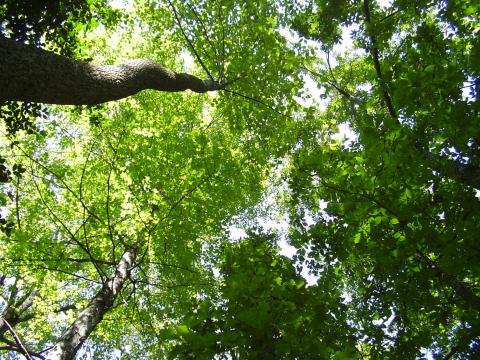
What does a tree growing faster than its neighbor look like from outer space? Beginning this summer, researchers from the University of Maryland Center for Environmental Science's Appalachian Laboratory will find out. Scientists Andrew Elmore and David Nelson were awarded $653,018 from National Aeronautics and Space Administration (NASA) for a three-year project to use satellite data to find out how the growth rate of trees in a longer growing season is impacting the environment.
"If trees are growing faster, than they are taking more carbon out of the atmosphere," said Dr. Andrew Elmore. "That's a good thing for global warming."
Previous studies have shown that the growing season--the length of time between when the leaves on trees turn green in the spring and turn colors in the fall--is growing longer. However, it's unclear whether the trees themselves are growing faster and taking more carbon dioxide from the atmosphere and cleaning the air.
This study will use satellite pictures of forests on the East Coast and the Mid-Atlantic, as well as data collected from airplanes and on the ground from tree core samples, to determine how trees are responding to this longer growing season, and how individual trees may be contributing the bigger picture.
The research proposal, "Assessing the influence of local phenology on the response of forest productivity to changes in growing season length," was funded by NASA's Science Mission Directorate's Earth Science Division and was one of 15 winning proposals out of 107 submissions.
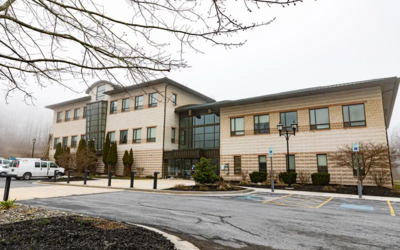
Scientists at the Appalachian Laboratory in Frostburg actively study the effects of land-use change on the freshwater and terrestrial ecosystems of the region, how they function in the Chesapeake Bay watershed, and how human activity may influence their health and sustainability on local, regional and global scales. The scientific results help to unravel the consequences of environmental change, manage natural resources, restore ecosystems, and foster ecological literacy.