News from UMCES

Tomorrow's Scientists

The saying goes: “Give a man a fish, and he’ll eat for a day. Teach a man to fish, and he’ll eat for a lifetime.” But teach a man the science of fish, and we all benefit.

Every year more than 100 graduate students come to the University of Maryland Center for Environmental Science to work side-by-side with some of the best environmental scientists in the world. Studying everything from the effects of development on stream ecosystems to new ways to feed fish in aquaculture, these men and women are training to solve environmental problems today so we have a better world tomorrow.

To celebrate graduate education, we will feature one such student each month.

Take the Facebook challenge

Help us reach 1,500 ‘Likes’ on our Facebook page by April 1 and one lucky ‘friend’ and a guest will be selected to join a science cruise on our research vessel, the Rachel Carson.

Don Boesch receives Energy & Environmental Leadership Award

Dr. Donald Boesch, one of the preeminent estuarine scientists in the world, has been honored with the Maryland-Asia Environmental Partnership’s 2011 MD Energy & Environmental Leadership Award.

The Maryland-Asia Environmental Partnership annually recognizes a Maryland leader who has provided both state and national leadership on energy and environment issues. Dr. Boesch was presented with the award by University System of Maryland Chancellor Dr. William E. Kirwan during the group’s third annual banquet to honor Maryland’s energy and environmental leaders.

Dr. Ed Houde receives Lifetime Achievement Award from American Fisheries Society

You really have to know your stuff to have a fish named after you. That’s why Bregmaceros houdei, a previously unknown species of three-inch codlet native to the Gulf of Mexico, was named after Ed Houde.

A professor at the University of Maryland Center for Environmental Science, he is an expert in the early life of fish—those crucial first 100 days that set the pattern for survival and abundance in adulthood. He was recently honored with the American Fisheries Society’s Elbert H. Ahlstrom Lifetime Achievement Award for his pioneering work and highly productive career studying the early life stages of fishes.

AL Honors Maryland Park Service’s Caroline Blizzard for Raising Environmental Awareness in Western Maryland

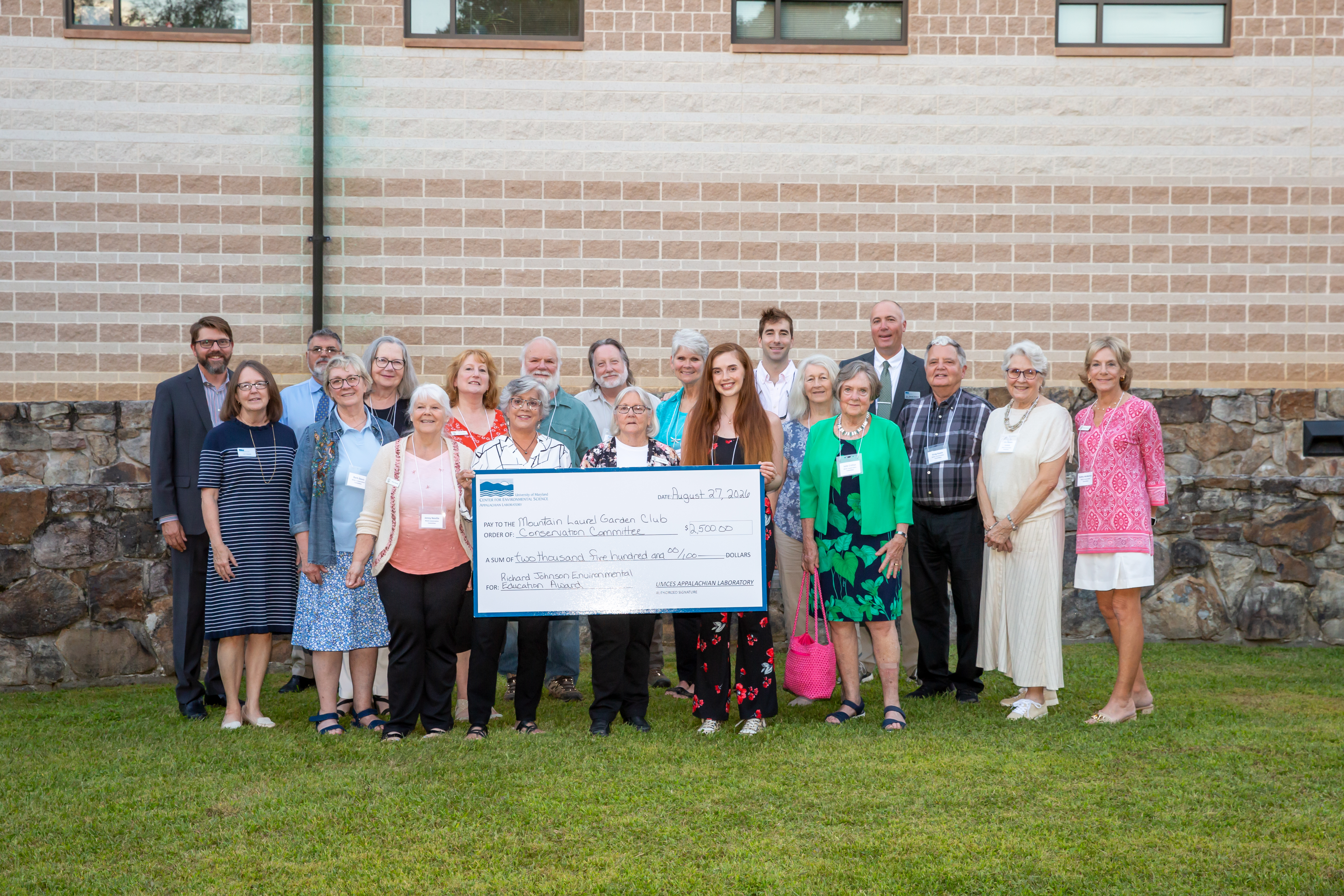
The University of Maryland Center for Environmental Science Appalachian Laboratory presented Maryland Park Service’s Caroline Blizzard its 2011 Richard A. Johnson Environmental Education Award recipient for helping elevate environmental stewardship and understanding throughout her western Maryland community.

Margaret Palmer Recognized by USM Regents for Advancing the Role of Science in Public Policy

University of Maryland Center for Environmental Science Chesapeake Biological Laboratory scientist Dr. Margaret Palmer has been awarded the University System of Maryland Regents’ Faculty Award for Excellence for her scientific work informing policymakers and the public about the environmental impacts of mountaintop mining and restoration ecology.

TAKE THE FACEBOOK CHALLENGE

Subtitle: 

Help us reach 1,500 ‘Likes’ on our Facebook page by April 1 and one lucky ‘friend’ and a guest will be selected to join a science cruise on our research vessel, the Rachel Carson.<

New Maryland Sea Grant Film Examines “Who Killed Crassostrea virginica?”

Subtitle: 
Film helps launch MPT's Chesapeake Bay Week 10:00 p.m. on April 10

The Chesapeake was once home to the richest oyster grounds in the world. The native oyster, Crassostrea virginica, built massive reefs and filtered vast reaches of the Bay, removing algae and sediment. Now those reefs are gone. The historic fishery is a mere shadow.

CBL Scientist Lauded for Research Linking Environmental Conditions and Japanese Crab Populations

Fisheries Biologist Dr. David Secor and Dr. Hiroyuki Ariyama of Japan will be honored by the Japanese Society of Fisheries Science for their research into how typhoons and low-oxygenated waters are impacting a crab native to the waters of Osaka Bay. 

Baltimore Harbor Health Assessment Sets Baseline for Renewed Cleanup Effort

The Inner Harbor has long been a focal point of life in Baltimore. Beginning as a vital shipping port in Colonial times, the area has grown over the past three hundred years and become one of the Mid-Atlantic’s major economic engines. While the region has thrived, the harbor has not. Today, the Harbor’s waters rank as some of the most polluted in the Chesapeake Bay watershed.