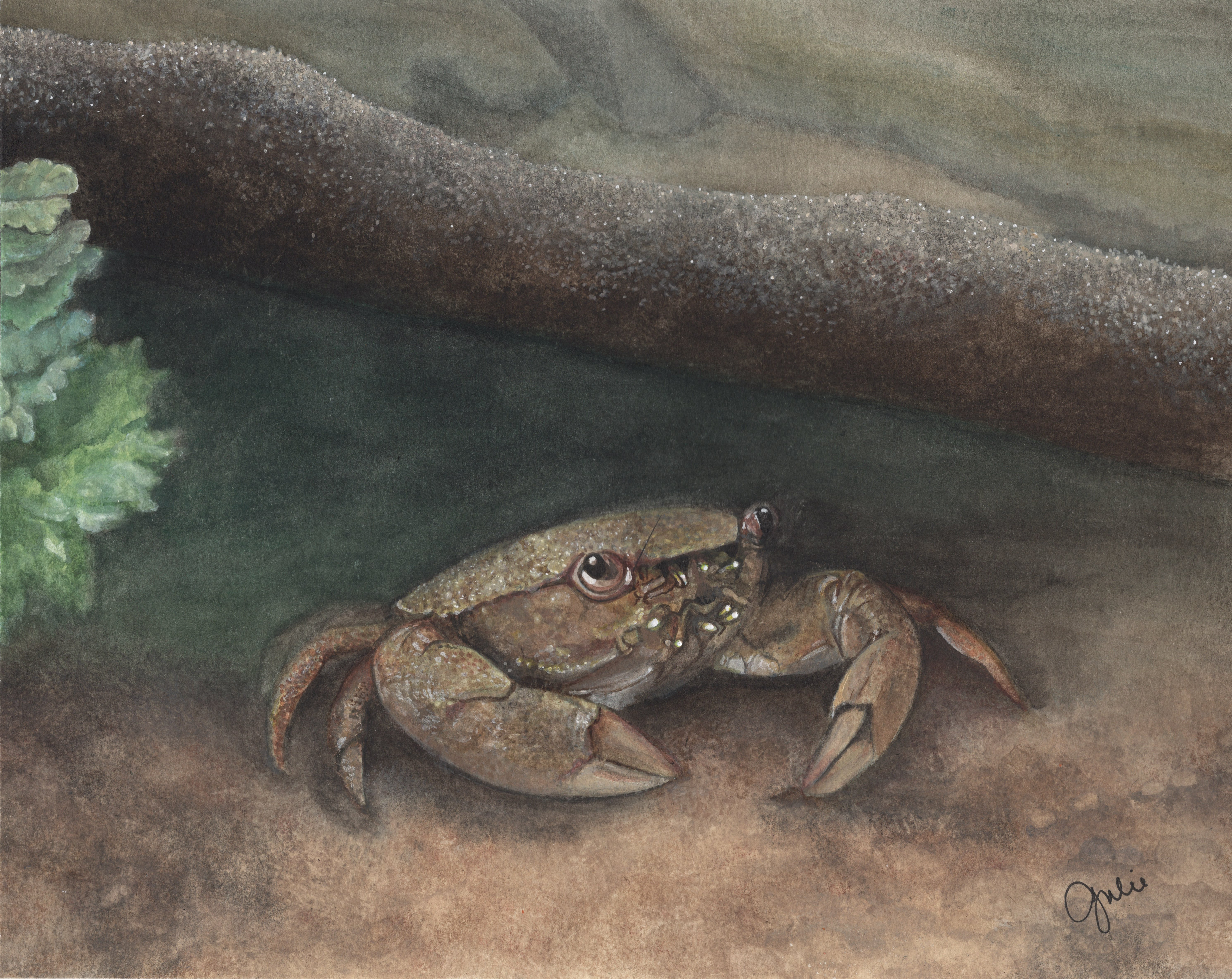
Meet the Mud Crabs
Five species of mud crabs call the Chesapeake home. Four of these have black-tipped claws: the flat mud crab (Eurypanopeus depressus), the common black-fingered mud crab (Panopeus herbstii), the equal-clawed mud crab (Dyspanopeus sayi), and the grooved-wristed mud crab (Hexapanopeus angustifrons). Our Critter of the Month for this very cold January is the fifth: the white-fingered mud crab (Rhithropanopeus harrisii). These members of the family Panopeidae are generally small, brown, and rather similar in appearance, earning their common name from their preference for muddy habitats such as marshes and oyster reefs. The white-fingered mud crab is distinguished by white-tipped claws of unequal size and grows to about 20 millimeters, or about three-quarters of an inch (Lippson and Lippson 2006). The species has accumulated a long list of common names: Harris mud crab (honoring American naturalist Thaddeus William Harris), estuarine mud crab, dwarf crab, and Zuiderzee crab (from its 1874 invasion of the Netherlands' Zuiderzee estuary). Despite their small stature, these crabs embody big questions about local ecology, global invasion, and the curious phenomenon of handedness in animals.
Like its sibling mud crabs, the white-fingered mud crab requires shelter and frequently inhabits oyster reefs, woody debris, and dock crevices. Pull away the bark of a waterlogged felled tree along the shores of the Chesapeake Bay and you might find dozens scuttling away. The species demonstrates remarkable adaptability, tolerating salinity levels from freshwater to nearly marine conditions across a broad temperature range, probably the most abundant crab in the lower to medium salinity waters of the Bay. Its native range extends along the Atlantic and Gulf coasts of North America extending from the Gulf of St. Lawrence to Veracruz, Mexico, reaching their greatest abundance in estuaries like the Chesapeake (Williams 1984).
White-fingered mud crabs play a pivotal role in the estuarine food web as both predators and prey. With their stout crushing claws, they can feed on well armored animals such as small oysters, barnacles, mussels, and snails (such as a previous Critter of the month, Marsh Periwinkle), as well as amphipods and worms. They are also valuable prey for birds, fish, and larger crustaceans. As one SERC scientist recently recounted, everyone on the oyster reef seems to eat them. The crabs are also subject to attack from an invasive parasitic barnacle, (Loxothylacus panopaei), which is the subject of ongoing research at SERC's Chesapeake Bay Parasite Project.
Our little mud crab, an invader?
In addition to its native range, the white-fingered mud crab has proven to be a highly successful marine invader. The species first appeared in Europe in 1874 in the Netherlands' Zuiderzee estuary, spread to the Kiel Canal by 1936, and has since colonized waterways across Western Europe and the Baltic Sea. In North America, it invaded San Francisco Bay in 1937 and recently established breeding populations in freshwater Texas reservoirs—the first records in freshwater inland lakes. The crab now inhabits four continents, with established populations in the Black Sea, Caspian Sea, Panama Canal, Japan, Venezuela, and Brazil. Its broad tolerance to temperature and salinity, combined with its ability to hitchhike within oyster reef communities, have been key to its spread far beyond its native range. The crabs likely disperse primarily via ballast water, ship fouling, and oyster aquaculture transfers.
Handed-ness in nature
Among the white-fingered mud crab's more curious features is its handedness. The crab's two claws are unequal in size, though not as prominently as the famously lopsided fiddler crab. The major "crusher" claw is short and stout, while the minor "cutter" claw is longer and straighter. In white-fingered mud crabs, this asymmetry shows a striking bias: 79-91% of Chesapeake Bay individuals are right-handed, with their crusher claw on the right side. This pattern appears throughout the mud crab family, with six of eight studied species predominantly right-handed, ranging from 66-83%. This right-handed majority contrasts sharply with fiddler crabs, where most species maintain a 50:50 split. The reasons for these differences are not clear.
The white-fingered mud crab's strong right-handed bias connects it to broader questions about lateralization across the tree of life, from limb preference among fish, rodents, and birds, and asymmetric helical growth in plants, to the mysterious dominance of right-handedness in humans. When a crab loses its dominant crusher claw, the minor claw can partially assume the crusher role, though imperfectly, suggesting that handedness results from neural regulation during development rather than fixed brain lateralization. So what drives right-handedness in mud crabs while fiddler crabs maintain an even split? Does handedness affect feeding efficiency or survival? These questions remind us that even the smallest residents of the Chesapeake can be a source of inspiration and study to understand fundamental patterns in nature.
Looking for More Information?
Chesapeake Bay Program. Black-Fingered Mud Crab Species Profile. https://www.chesapeakebay.net/discover/field-guide/entry/black-fingered-...
Guerra, S., U. Castiello, B. Bonato, and M. Dadda. 2024. Handedness in animals and plants. Biology 13:502. https://doi.org/10.3390/biology13070502
Kulp, R.E., V. Politano, H.A. Lane, S.A. Lombardi, and K.T. Paynter. 2011. Predation of juvenile Crassostrea virginica by two species of mud crabs. Journal of Shellfish Research 30:261-266. https://doi.org/10.2983/035.030.0210
Lippson, A.J. and R.L. Lippson. 2006. Life in the Chesapeake Bay, 3rd edition. Johns Hopkins University Press, Baltimore.
Milke, L.M. and V.S. Kennedy. 2001. Mud crabs in Chesapeake Bay: claw characteristics and predation on epifaunal bivalves. Invertebrate Biology 120:67-77. https://doi.org/10.1111/j.1744-7410.2001.tb00027.x
Smithsonian Environmental Research Center (SERC). 2023. Chesapeake Bay Parasite Project. https://serc.si.edu/participatory-science/projects/chesapeake-bay-parasi...
U.S. Geological Survey (USGS). 2021. Harris Mud Crab (Rhithropanopeus harrisii) Species Profile. Nonindigenous Aquatic Species Database. https://nas.er.usgs.gov/queries/factsheet.aspx?speciesid=197