Meet the Seaside Dragonlet
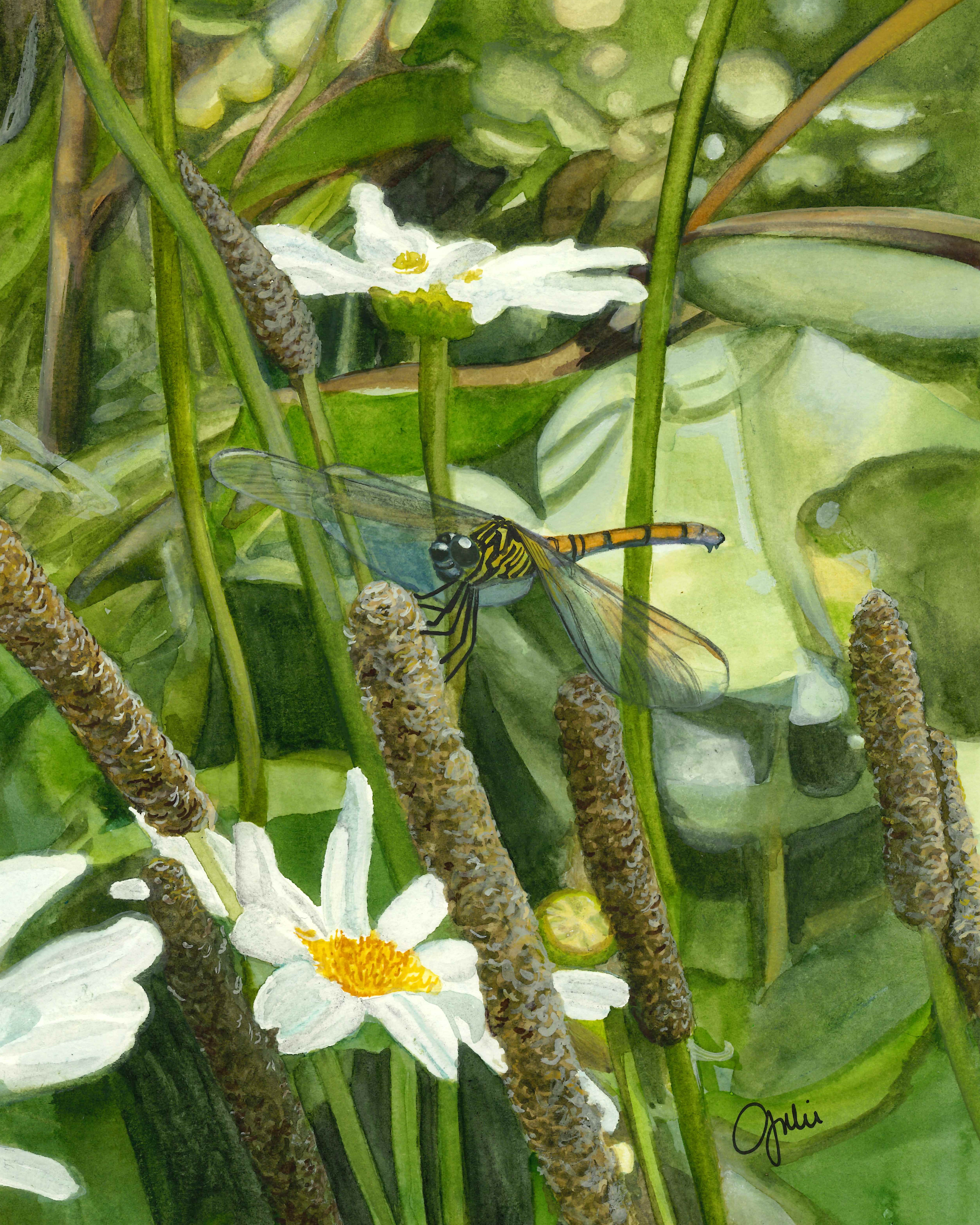
This month’s Critter of the Month is the Seaside Dragonlet. Dragonlets are dragonflies (Odonata) from the skimmer family (Libellulidae) that belong to a particularly diminutive genus Erythrodiplax. While most dragonflies you’re likely familiar with are 2 or more inches in length, dragonlets are generally closer to 1 inch long. Males are deep black or blue-black while females are frequently more colorful, typically with a lemon-yellow to orange thorax with bold black striping, and a distinctive chainlike alternation of orange and black along the middle segments of the abdomen, as seen in this watercolor. Regardless of its coloration though, identification in the field is fairly straightforward: if you find yourself in a salt marsh in summer and spot a small dragonfly perched on a stem, you are almost certainly looking at a Seaside Dragonlet.
Brackish Life:
While the vast majority of dragonflies depend on freshwater for larval development, the Seaside Dragonlet breeds in the tidal coastal wetlands of Atlantic and Gulf Coast marshes. Adults are most abundant from late spring through summer, where they perch on vegetation, such as the culms of smooth cordgrass (Spartina alterniflora), making it the only truly marine dragonfly in this part of the world. For an insect with wings, they seem fairly reluctant to use them: a small behavioral study at a Maine salt marsh observed that individuals spent roughly 99% of their time perched, taking flights of only a few seconds and rarely traveling more than a foot or so from their starting point (Wilson 2008). This relatively slow lifestyle may make good sense in a marsh environment where staying still reduces energy expenditure and exposure to the spiders and birds that hunt them.
A Species on the Move: Range Expansion and Climate Change
The Seaside Dragonlet’s core range runs along the Gulf and Atlantic coasts of the USA, but recent records suggest the species is pushing to higher latitudes. In 2020, they were documented for the first time at multiple locations along the Bay of Fundy in New Brunswick, Canada, and this range expansion tracks with warming waters and regional air temperatures (Sabine et al. 2023). The Seaside Dragonlet is far from alone in this northward drift: a study of British dragonflies and damselflies found that 37 species had shifted their northern range poleward over 40 years, tracking warming habitats (Hickling et al. 2005).
At the PhytoChop Observatory, we are using a technique called environmental DNA (“eDNA”) to trace aquatic organisms in the Choptank River. We are capturing and analysing the sequences of DNA shed into the water to identify which animals have been present and in what seasons. We are currently establishing robust baseline information about which organisms are effectively targeted by this technique and building the capacity to detect shifts in community composition.
So next time you visit a salt marsh on a warm summer’s day, see if you can find a Seaside Dragonlet, likely perched motionless on vegetation and unbothered by the salt, doing what its kind has done in coastal marshes for a very long time.
Looking for More Information?
Hickling, R., D.B. Roy, J.K. Hill, and C.D. Thomas. 2005. A northward shift of range margins in British Odonata. Global Change Biology 11(3): 502–506.
Sabine, D.L., M.E.J. Sabine, and H.S. Makepeace. 2023. First records of Seaside Dragonlet (Erythrodiplax berenice) in New Brunswick, Canada: range expansion possibly mediated by climate warming. Canadian Field-Naturalist 137(1–2): 120–124.