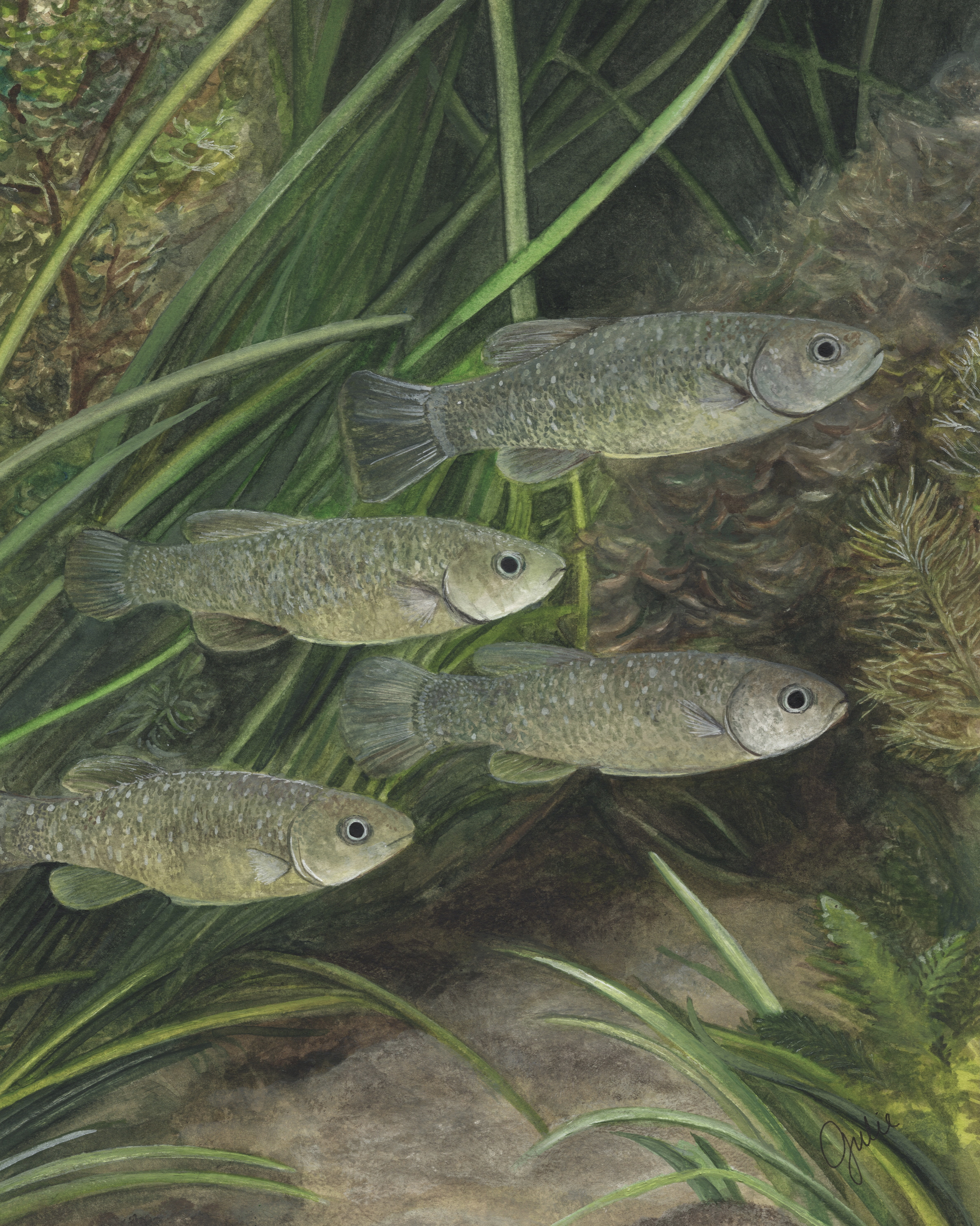
Meet the Mummichogs
Paddle around a Chesapeake salt marsh and there’s a good chance you’ll encounter schools of broad-headed minnow-like fish weaving over the muddy shallows at high tide and darting about the edges of the marsh at low tide. These are mummichogs (Fundulus heteroclitus), killifish whose familiar name derives from a Narragansett word meaning "going in crowds", earned from their habit of travelling in large schools. Mummichogs are often the most abundant fish in salt marshes, muddy creeks, and brackish estuaries and are distributed widely along the Atlantic coast, from southern Newfoundland to northern Florida. Typically growing to under 4 inches long (< 10 cm), mummichogs are generally greenish brown with an upturned mouth and protruding lower jaw. They display countershading, meaning they are darker on their back and lighter on their belly, a strategy that helps them camouflage from predators looking down (blending in with the muddy bottom) and from bottom predators looking up (blending in with the bright surface). During breeding season, males also develop silvery vertical bars on their sides and yellow or orange bellies. They're important trophic links in the estuarine food web, feeding on small crustaceans, worms, insect larvae, and amphipods while serving as prey for striped bass, weakfish, herons, and other predators.
Adult mummichogs forage on the marsh platform during high tide and retreat to tidal creeks at low tide. From spring through fall, they spawn on the highest monthly tides (new or full moons), with females laying eggs in the upper marsh in moist spaces such as empty ribbed mussel shells and the inside surfaces of cordgrass leaves. The eggs mature over a few weeks and hatch once fully immersed in water during the next high spring tide. The tiny larvae then face a harsh landscape on the marsh platform. Shallow pools left by retreating water can reach temperatures exceeding 100°F (>37 oC), and have diminishing oxygen levels. Yet for mummichog juveniles, the sun-baked pools offer better survival odds than the tidal creeks, where voracious grass shrimp would make a quick meal of them. Notably, mummichog populations fare better in native smooth cordgrass (Spartina alterniflora) marshes than areas invaded by common reed (Phragmites australis), which leaves the marsh platform too dry for larval fish.
Adaptations to Extreme Conditions
Life in salt marshes requires sophisticated adaptations to extreme variations in temperature, salinity, and oxygen, and mummichogs are champions at acclimating to variable conditions. They tolerate not only broad temperature ranges over the season, but also rapid temperature fluctuations over single tidal cycles (e.g., 15-30°C or 59-86°F). They can do so by altering their metabolic rates and switching between enzyme variants optimized for warm or cold water. They can also acclimate to salinity levels from near freshwater to three times greater than seawater. Perhaps most intriguingly, when oxygen drops to about 1 mg/L (lethal to most fish), mummichogs use aquatic surface respiration, gulping air and absorbing oxygen through highly vascularized tissue in their mouths and gills. Mummichogs also show remarkable pollution tolerance. Populations in heavily polluted waterways have evolved a degree of resistance to toxins, with up to 20% of their genes modified relative to clean-site populations.
A Model, a Sentinel, and a Space Pioneer
You might already be familiar with two "fun facts" about these fish. Due to their broad environmental tolerances, mummichogs are particularly hardy and relatively easy to keep in captivity. They are therefore unsurprisingly among the most widely sold baitfish in tackle shops, especially popular for catching summer flounder in the Chesapeake Bay. They were also the first fish in space. In 1973, NASA flew two mummichogs and 50 eggs aboard the Skylab 3 mission to study how fish fare in zero gravity. (For the exceptionally curious: The adults initially swam oddly, but normalized within 3 weeks, and among the embryos, more than 90% hatched and all swam normally).
But you may be less familiar with the importance of mummichogs in science on Earth today. They're model organisms for understanding the genetics of physiological adaptations and responses to environmental stress. Mummichogs are also valuable biosentinels for environmental monitoring. With high site fidelity, and narrow home range, in the summer typically staying within a hundred feet of the same shoreline, any contaminants they pick up trace to that specific location. This combination of restricted movement and pollution tolerance makes them excellent indicators of local water quality and sentinels for testing the efficacy of ecosystem restoration.
Looking for More Information?
Burnett, K.G., Bain, L.J., Baldwin, W.S., et al. 2007. Fundulus as the premier teleost model in environmental biology: Opportunities for new insights using genomics. Comparative Biochemistry and Physiology Part D: Genomics and Proteomics 2(4): 257-286. https://doi.org/10.1016/j.cbd.2007.09.001
Crum, N.J., Able, K.W., and Chambers, R.M. 2018. Growth and Movements of Mummichogs (Fundulus heteroclitus) Along Armored and Vegetated Estuarine Shorelines. Estuaries and Coasts 41(Supplement 1): S131-S143. https://doi.org/10.1007/s12237-017-0299-x
Good, M. 2016. Measuring the Functional Equivalency of Restored Salt Marshes to Natural Salt Marshes in the Southern Branch of the Elizabeth River, Virginia. MS thesis, Old Dominion University. https://www.proquest.com/docview/1803253119
Lippson, A.J. and Lippson, R.L. 2006. Life in the Chesapeake Bay. 3rd edition. Johns Hopkins University Press, Baltimore, Maryland.
Moore, C. What are Mummichogs (And Why Are They Amazing). YouTube video, May 2020. https://www.youtube.com/watch?v=bmqCM4c_KjI
Reebs, S. 2009. Fish in Space. http://www.howfishbehave.ca/pdf/Fishes%20in%20space.pdf
Sherr, E. 2017. Marsh Mud and Mummichogs: An Intimate Natural History of Coastal Georgia. University of Georgia Press, Athens, Georgia.
Stierhoff, K.L., Targett, T.E., and Grecay, P.A. 2003. Hypoxia tolerance of the mummichog: the role of access to the water surface. Journal of Fish Biology 63(3): 580-592. https://doi.org/10.1046/j.1095-8649.2003.00172.x
Whitehead, A., Galvez, F., Zhang, S., Williams, L.M., and Oleksiak, M.F. 2011. Functional Genomics of Physiological Plasticity and Local Adaptation in Killifish. J. Heredity 102: 499-511. https://doi.org/10.1093/jhered/esq077