Meet the Bottlenose Dolphins
While many of our Critter of the Month features have highlighted organisms visible only under a microscope, our subject for this March is one of the ocean’s most iconic marine mammals, the bottlenose dolphin (Tursiops truncatus), which calls the Chesapeake one of its seasonal homes. Bottlenose dolphins can be seen Lower Bay Virginia waters throughout the year, especially near the mouth of the Bay at the Atlantic Ocean. Each year, they also swim upstream into Maryland waters, arriving in April and staying through October, with peak sightings occurring in July. They can reach up to 12 feet in length and weigh between 300 and 400 pounds. The species gets its common name from its distinctive short, beak-like snout.
As marine mammals, bottlenose dolphins are warm-blooded air-breathers, fundamentally different from the fish that share their habitat. While fish propel themselves with vertical tail fins that sweep side to side, dolphins swim using horizontal tail flukes that move up and down, making them look more like a galloping horse. These different swimming strategies reflect their different evolutionary histories: fish evolved in water over hundreds of millions of years, while dolphins trace their ancestry to four-legged, hoofed land mammals that returned to the sea approximately 50 million years ago. Even modern dolphin today still retain vestigial pelvic bones from their terrestrial ancestors. The massive musculature of dolphins enable them to reach speeds of 12 or more knots over short distances when motivated, though they typically cruise at a more leisurely pace.
In Chesapeake Bay, bottlenose dolphins hold the position of apex predators: top consumers with few natural threats beyond humans and large sharks. Their presence indicates a highly productive food web capable of supporting these large animals. Dolphins are famously social creatures, traveling in groups called pods, that in the Chesapeake, are frequently small, containing 2 to 15 individuals, though numerous reports of pods exceeding 100 dolphins have also been reported to DolphinWatch. Within these pods, dolphins communicate using a sophisticated repertoire of sounds including clicks, squeaks, whistles, and creaks. Researchers believe each dolphin develops its own unique signature whistle, akin to a personal name, that other dolphins can recognize and use to call to specific individuals.
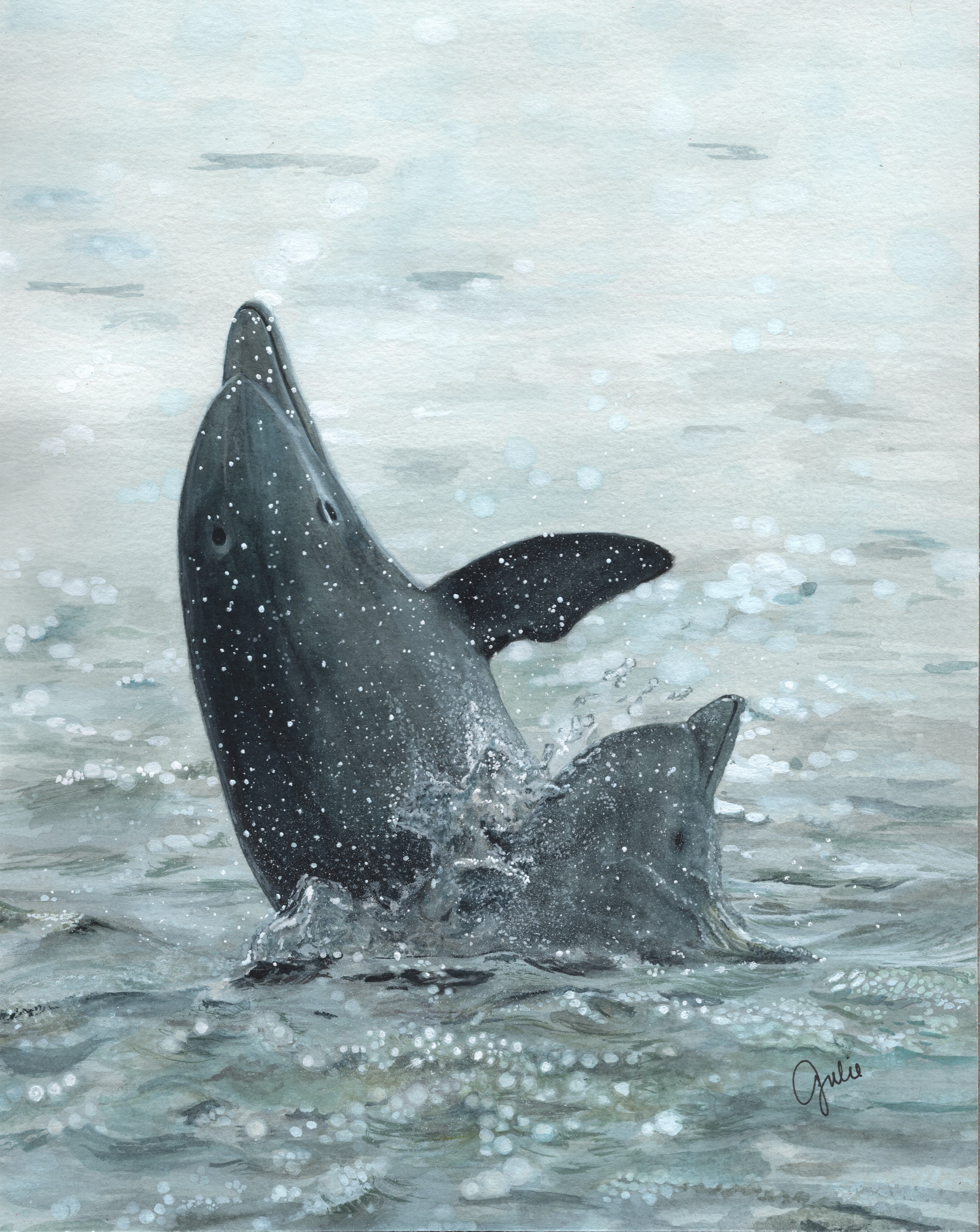
What’s Happening in This Image?
In this watercolor, two dolphins swim in close formation, with the dolphin on the left appearing to launch itself higher out of the water, perhaps preparing for a side flop to land on its side with a splash. While we don’t know with certainty what these particular dolphins are doing, different types of aerial behaviors can serve a variety of purposes. Some behaviors serve as non-vocal communication signals between pod members, with the loud smack of a body hitting the water conveying information over relatively short distances, ranging from a few meters to hundreds of meters. Other aerial displays occur during social interactions, with certain jumps signalling competition and others accompanying high-speed chasing. Whatever the specific activities of these two dolphins, their interactions reflect the tight social coordination that characterizes life in a bottlenose dolphin pod.
Project DolphinWatch and the PhytoChop Observatory: Different Tools for Different Scales
Researchers at the University of Maryland Center for Environmental Science launched the Chesapeake Dolphin Watch program in 2017, building upon and complementing the ongoing work of the Potomac-Chesapeake Dolphin Project. The Potomac-Chesapeake Dolphin Project was initiated in 2015 from Georgetown University, and tracks individual dolphins through photo-identification of distinctive markings on their dorsal fins as part of a broader study of ecology and behaviour of dolphins in this system. DolphinWatch expanded this research Bay-wide through two key components: acoustic monitors called hydrophones to detect dolphin echolocation clicks, alongside a community science mobile app that enables anyone on the Bay to become a dolphin observer. Between 2017 and 2025, over 20,000 thousand registered users reported over 7,500 confirmed dolphin sightings, revealing key seasonal patterns. Dolphins typically arrive in Middle Bay in April, spreading north by July, and retreating south to the Lower Bay by October. Spatially, sightings tend to be concentrated around tributary mouths like the Potomac, Rappahannock, and York rivers. Underwater acoustic monitors detecting dolphin echolocation clicks correlate closely with reported sightings, confirming what DolphinWatch observers are reporting.
This community-based approach is extremely valuable for tracking mobile, wide-ranging species like dolphins. An individual dolphin might travel 30 kilometers in a day, with home ranges spanning from North Carolina to New Jersey, which presents a challenge for efficient tracking. Efforts such as DolphinWatch provide an effective way to track these animals.
This Critter of the Month project is associated with our PhytoChop coastal observatory project on the Choptank River, where we track both microscopic organisms and the shed cells of animals that, for the most part, drift passively with the movement of the water (though some small organisms can move up and down in the water column). Building a complete picture of Chesapeake Bay biodiversity and ecology requires matching our tools to the organisms we study. From diatoms to dolphins, each group demands different scales of observation and monitoring technologies. Single-station sampling (such as our Observatory) efficiently captures the seasonal changes in the microscopic foundations of the food web. Citizen science networks reveal movements of apex predators and acoustic monitors can helps bridge gaps, detecting echolocating animals we can't always see. Together, these complementary approaches allow us to understand the Bay as an integrated ecosystem.
Looking for More Information?
UMCES DolphinWatch: https://www.umces.edu/dolphinwatch
Video: "Bottlenose Dolphins in the Chesapeake Bay" https://www.youtube.com/watch?v=BkLbzMa3Ha4
Potomac-Chesapeake Dolphin Project: https://www.pcdolphinproject.org/
Bay Journal: "Chesapeake dolphins thrill spotters, scientists" https://www.bayjournal.com/news/wildlife_habitat/chesapeake-dolphins-thr...
Chesapeake Bay Program Field Guide: "Bottlenose Dolphin (Tursiops truncatus)" https://www.chesapeakebay.net/discover/field-guide/entry/bottlenose-dolphin
NOAA Fisheries: "Common Bottlenose Dolphin" https://www.fisheries.noaa.gov/species/common-bottlenose-dolphin
Rodriguez, L.K., Fandel, A.D., Colbert, B.R., Testa, J.C., Bailey, H. (2021). Spatial and temporal variation in the occurrence of bottlenose dolphins in the Chesapeake Bay, USA, using citizen science sighting data. PLoS ONE 16(5): e0251637. https://doi.org/10.1371/journal.pone.0251637
Lusseau, D. (2006). Why do dolphins jump? Interpreting the behavioural repertoire of bottlenose dolphins (Tursiops sp.) in Doubtful Sound, New Zealand. Behavioural Processes 73: 257–265. https://doi.org/10.1016/j.beproc.2006.06.006