All Ears in the Ocean
With acoustic monitoring off the Maryland coast, UMCES scientists are helping industry and regulators learn how to better protect critically endangered right whales.
By Wendy Mitman Clarke
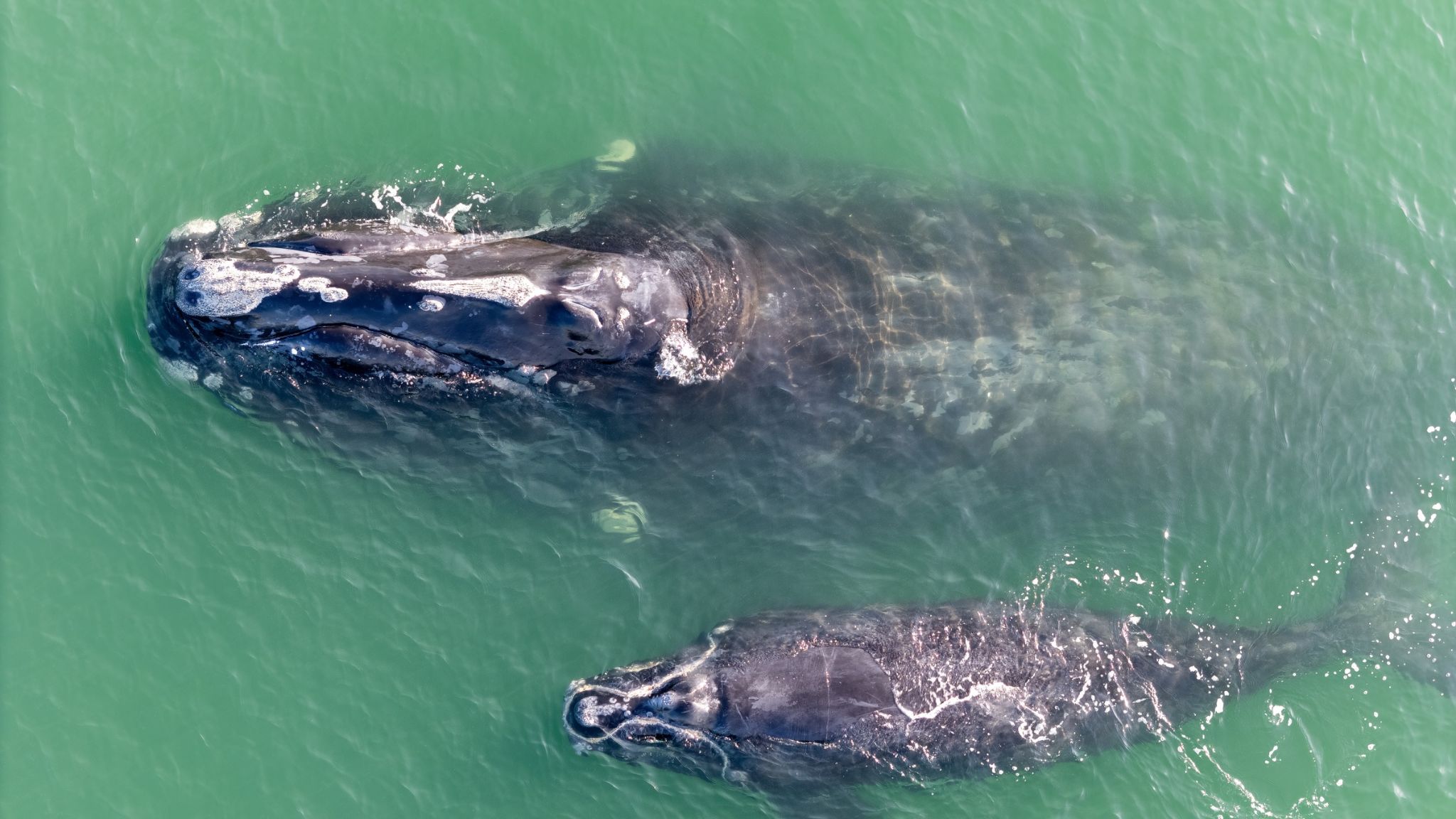
Featured image: North Atlantic right whale #1515 “Ghost” and her ninth calf, swimming just offshore of Flagler Beach, Florida, on January 30, 2026. Credit: Marineland Right Whale Project/Zoe Rauscher, taken under NOAA permit #26562.
In early April 2024, experts in whale deaths examined the body of North Atlantic right whale #1950, a female last spotted off northern Florida two months earlier with her calf. Hauled ashore for necropsy after being found about 50 miles off the Virginia coast, her body bore clear evidence of a ship strike.
“Preliminary findings included catastrophic injuries with a dislocation of the whale’s spine and fractures to all vertebrae in the lower back. These findings are consistent with blunt force trauma from a vessel strike prior to death,” noted NOAA Fisheries’ North Atlantic Right Whale Health Updates 2024. The calf she had last been seen with was her documented sixth.
“The loss of a reproductive female is particularly devastating to the population, and this whale had a young, dependent calf,” the update said. “The calf has not been seen since it was last spotted with its mother on February 16, 2024, off Amelia Island, Florida. We do not expect the calf to survive without protection and nursing from its mother.”

Dead female North Atlantic right whale #1950 on the beach in Virginia. The necropsy team leaders examine the whale at the landing site, before using the heavy black towing line to bring it ashore. Experts completed a necropsy on April 2, 2024. Necropsy findings are consistent with blunt force trauma from a vessel strike prior to death. Credit: Virginia Aquarium and Marine Science Center, taken under NOAA permit #24359.
First identified in September 1989 just south of Nova Scotia’s Cape Sable Island, #1950 traveled along the East Coast year after year, migrating south to calving grounds off the Carolinas, Georgia, and Florida during winter months, then north in spring to feed in New England and Canadian waters all summer.
This migratory path is fraught with dangers for critically endangered right whales, most prominently from entanglement in fishing gear and collisions with vessels. Now, University of Maryland Center for Environmental Science (UMCES) researchers, who have been using acoustic monitoring to study whale movements off the coast of Maryland, are learning that right whales may be spending more time in the mid-Atlantic than previously thought—a finding that is having management and conservation significance. And, using real-time acoustic data from a buoy located 27 miles off Ocean City, they are helping lower the risk of vessel strikes by providing ships and regulators immediate information about whale movements.
Credit NOAA Fisheries. Tagging data collected by HDR Inc., the U.S. Fleet Forces Command, and the Naval Facilities Engineering Services Command Atlantic for the data under NOAA permit #21482.
“Whenever a North Atlantic right whale is detected within our data, depending on the timing, that can activate a Slow Zone,” says Kirsten Silva, a faculty research assistant at Chesapeake Biological Laboratory (CBL) and lead analyst on the Real-Time Whale Buoy (RTWB) project. “This is a period of time up to 15 days in which vessels in the area are voluntarily requested to slow down to 10 knots or less. And then if another North Atlantic right whale is detected within the last seven days of that 15-day period, the Slow Zone will actually extend.”
These real-time Slow Zones are voluntary, unlike Seasonal Management Areas (SMAs)—zones in which vessels over 65 feet long may not travel faster than 10 knots (11.5 mph). SMAs take effect annually along the coast for periods of time when whales are known to be most present. For instance, in two zones off the mouths of Chesapeake and Delaware bays, ships may not exceed 10 knots from November 1 to April 30.

Credit NOAA Fisheries.
“We do think that the voluntary actions are useful, some mariners and commercial vessels do pay attention to that,” says Dave Secor, CBL professor and lead scientist for UMCES TailWinds—a multifaceted research program, including the Real-Time Whale Buoy, that’s studying how marine species in the mid-Atlantic may be affected by human impacts, in particular offshore wind development. “So it’s an exciting application because it is using real-time information directly in terms of the potential management of practical use.”
Caroline Tribble, a CBL faculty research assistant and lead analyst on the Marine Mammal Monitoring Project, funded within TailWinds by US Wind, says that Slow Zones have been “active on average 71% of the time of right whale season…it’s a really difficult conversation to have with stakeholders, but it begs the question, at what point do we make this temporary, seasonal dynamic management actually static? Because with what we’re seeing year after year, we can pretty confidently say they’re going to be here during that time period.”
Yet even though voluntary, the real-time Slow Zones are one more tool in the effort to protect the population of North Atlantic right whales, which are perilously close to extinction.

The 2024 calf of #1612 “Juno” was seen bleeding from previously documented vessel strike wounds on February 26, 2024 off St. Andrew Sound, Georgia. The calf was found dead on March 3, 2024. Credit: Georgia Department of Natural Resources taken under NOAA permit #24359.
A Species on the Edge
Apocryphally, the whale’s name refers to it being the “right whale” to hunt, because it’s a relatively slow, coastal swimmer that floats when dead. They have been hunted since the 11th century, when Basques began taking them in the Bay of Biscay, and by the mid-1500s from the waters off Newfoundland. American whalers pursued them on the East Coast, but by the turn of the 20th century they were “commercially extinct, i.e. too few to hunt,” notes the North Atlantic Right Whale Consortium, a group of more than 200 agencies, scientists, and organizations begun in 1986 to share data on the whales. “No one knows for sure how many right whales were killed in the North Atlantic before they were finally protected from hunting in 1935, or how many right whales existed before whaling began.”
By 1970 they were listed on the Endangered Species Act; only an estimated 319 remained in 2000. By 2011, NOAA Fisheries estimated 483 individuals, but beginning in 2014, deaths began to exceed births. In 2017, more than 40 deaths with just five births were reported; a year later some 20 deaths were documented and zero births.

Credit NOAA Fisheries.
In 2017, NOAA Fisheries declared an Unusual Mortality Event (UME) for right whales; since then, the agency reports, “at least 18 right whales have been confirmed dead or observed seriously injured due to vessel strike. Many vessel strike injuries go undetected, as visual observations of live whales do not account for possibility of internal blunt force trauma injuries.” Additionally, “at least 46 right whales have been confirmed dead or observed seriously injured due to entanglement. Estimates suggest the true number is likely closer to 100 due to unobserved deaths.”

Credit NOAA Fisheries.
In November 2026, the North Atlantic Right Whale Consortium released its 2025 population estimate of 382 living right whales, representing “a 1.8 percent decline in population size from the 2024 estimate, which was recalculated as 389 (+/-3). The estimated number of reproductive females held steady at 73 (+3/-2),” the consortium noted in a press release.
“The newly released right whale population estimate underscores that more work is needed to protect this species,” said Heather Pettis, who leads the right whale research program in the New England Aquarium’s Anderson Cabot Center and chairs the consortium. “The population is not yet on a clear path to recovery and is incredibly vulnerable to entanglements and vessel strikes, threats we know how to reduce. Recovery for this species depends on sustained protective actions in both the U.S. and Canada.”
In April 2026, NOAA Fisheries reported 23 calves born this season, the highest number since 2009. The agency also noted that 13 females exhibited a healthier interval of three to four years between calves, rather than the recent average of seven to 10 years.
“There’s a reason to be excited definitely about any live calves, but getting those calves to adulthood, they’ve still got a long way to go,” says TailWinds co-lead Helen Bailey, who began studying acoustic signatures of marine mammals off Maryland while an associate research professor at CBL.

Credit NOAA Fisheries.
Listening to Learn
The Real-Time Whale Buoy (RTWB) has been in place for five years, anchored in about 100 feet of water near the shipping lanes leading to the Delaware Bay. It’s within the MarWin area, the first phase of US Wind’s 80,000-acre lease for wind development that is projected to provide 1,800 megawatts of electricity, enough to power half a million homes annually.
US Wind is a partner in UMCES TailWinds, which in collaboration with multiple partners includes passive acoustic and telemetry arrays that can detect and record presence of whales and electronically tagged sharks, turtles, and fish. Built and deployed by Woods Hole Oceanographic Institute (WHOI) and purchased by Maryland Department of Natural Resources, the RTWB is part of a series of WHOI-supported buoys and autonomous vehicles along the coast that gather data to help improve conservation of right whales. Since the buoy’s launch in 2021, DNR and US Wind help fund and maintain the buoy. (opens in a new tab)

Credit UMCES TailWinds.
Able to detect calls within a 10-kilometer (6.2-mile) radius, the buoy’s processing unit on the seabed records sound and “runs a very coarse kind of algorithm that detects a handful of different species of whales,” Secor says. (You can find a recording of these sounds on this page (opens in a new tab).) It sends that data up a helical stretch hose to the buoy on the surface, where it’s transmitted via satellite to WHOI’s Robots4Whales website (opens in a new tab) and UMCES analysts. They examine these “pitch tracks”—visual renderings of whale calls—daily to verify presence and species of whales, which, off Maryland, are predominantly humpback and fin whales.

This pitch track shows the calls of a North Atlantic right whale transmitted from the Real-Time Whale Buoy to UMCES analysts on February 16, 2023. The y-axis is the frequency in Hz and the x axis is time in seconds. Credit: Robots4Whales Ocean City, MD
Along with providing data to activate Slow Zones, the RTWB, coupled with monitoring from other acoustic assets within the TailWinds area, is also helping reveal a potential change in behavior among right whales. Studying archived acoustic data from 2014 to 2017, newly collected array data from 2023 to 2024, and RTWB data since 2021, Tribble and Silva have found that pitch tracks of other whale species show clear evidence of arrival and departure from the area in two peaks of acoustic activity, correlating with their annual migrations north and south.
“But with North Atlantic right whales, especially in the more recent years, we’re only seeing one single peak,” Tribble says. “So that’s telling us that maybe the whales are actually staying in this area a little bit longer than just passing through.” This is significant because of the proximity of shipping in Delaware and Chesapeake bays, including the major port of Norfolk near the Chesapeake’s entrance. “They’re all very busy shipping lanes, so they’re very dangerous areas. And if North Atlantic right whales are staying in this mid-Atlantic region a little bit longer than we would think, or originally thought, then this area needs to be a priority for monitoring the species so we can assist in, hopefully, keeping their mortality rate down.”
Tribble presented her research in October at the Society of Marine Mammalogy’s biennial conference in Puerto Rico; she and Silva are developing a paper to be submitted for publication within the next few months.
Silva has also been using the acoustic data to learn that right whales change their calling behavior in response to vessel noise. This research came about when US Wind in 2021 was conducting geotechnical surveys in the wind development area. There was so much vessel noise in the RTWB data it was difficult to discern whale calls at all. Silva wondered whether the whales faced the same kind of problem.

North Atlantic right whale #3904 “Champagne” spotted near the mouth of the Chesapeake Bay during the 2025 Atlantic Marine Assessment Program for Protected Species Survey. Champagne was born in 2009 and has had two calves, including one born in November 2025. Credit: NOAA Fisheries/Michelle Klein
“If an environment’s soundscape has changed so much in four months, how are they making their adjustments?” she says. Right whales use “up-calls” as a contact call. “They’ll communicate these calls in bouts, periods of time where there’s high calling activity. These bouts were getting shortened in response to higher sound pressure levels of the vessel passages. So maybe these right whales had just figured out that it was too energetically costly to keep calling.” She notes that her sample rate for data analysis the first year was about 100 up-calls. “For year two, when those geotechnical surveys weren’t operating, I collected 711 up-calls.”
The calls are also changing length and frequency for three to four hours after a vessel has passed, Silva says. “It’s kind of like when you come out of a concert, and your ears are still ringing, and maybe you’re talking louder than you actually need to be talking because you’ve been exposed to so much loudness…we’re kind of seeing a similar effect with the North Atlantic right whales. After about three to four hours, they’ve recovered enough and they’ve reached their normal calling parameters.”
Silva’s paper, “Transient changes in calling behavior of North Atlantic right whales associated with vessel noise,” has been accepted and is in process of publication in Conservation Science and Practice.
As this new research begins to inform how to conserve the fragile population of right whales, Bailey says maintaining support for the acoustic network and the real-time buoys is critical. The UMCES-monitored Ocean City real-time buoy, for instance, is currently funded only through 2027.
“This is paying off. We are seeing fewer ship strikes off Canada, and it’s been great in the last year to have that little bit of a glimmer of hope that maybe, more calves are being born,” she says. “But we’ve got to keep at it. The numbers are still so low. It’s just all too easy for things to go downhill again. And I think the fear is we’re in a situation right now where we have a pretty good network of these buoys that are forming the Slow Zone system. It’s not perfect, it’s in a voluntary system, but at least it’s something. And right now, those buoys are all individually funded, and that funding is just falling like a stone. So, in another year or two, half that network may be gone.”
In its 2025 report card, the North Atlantic Right Whale Consortium concurred: “The dramatic shifts in distribution observed for North Atlantic right whales over relatively short periods of time underscore the continued need for management efforts that protect right whales not only in habitats/areas where they are currently known to frequent, but also areas to which they may shift, be it ephemeral or more stable use.”
Tribble says continued monitoring is also necessary to educate people about these species we share coastal waters with. Growing up in Rockville, Maryland, she had no idea whales were right off Ocean City. When she came to CBL, she says, “It was kind of shocking to me to realize how much marine mammal work was going on here. Most people I talk to don’t even know what a right whale is, so bringing more awareness is a goal of mine, and being able to continue monitoring the species for when we can implement more conservation measures.”
Wendy Mitman Clarke is a science writer and sailor who lives on Maryland’s Eastern Shore. See more of her work at wendymitmanclarke.com.