Hazardous Hitchhikers
The closure of the Strait of Hormuz has created conditions for a “super-spreader” event of marine invasive species worldwide.
By Wendy Mitman Clarke
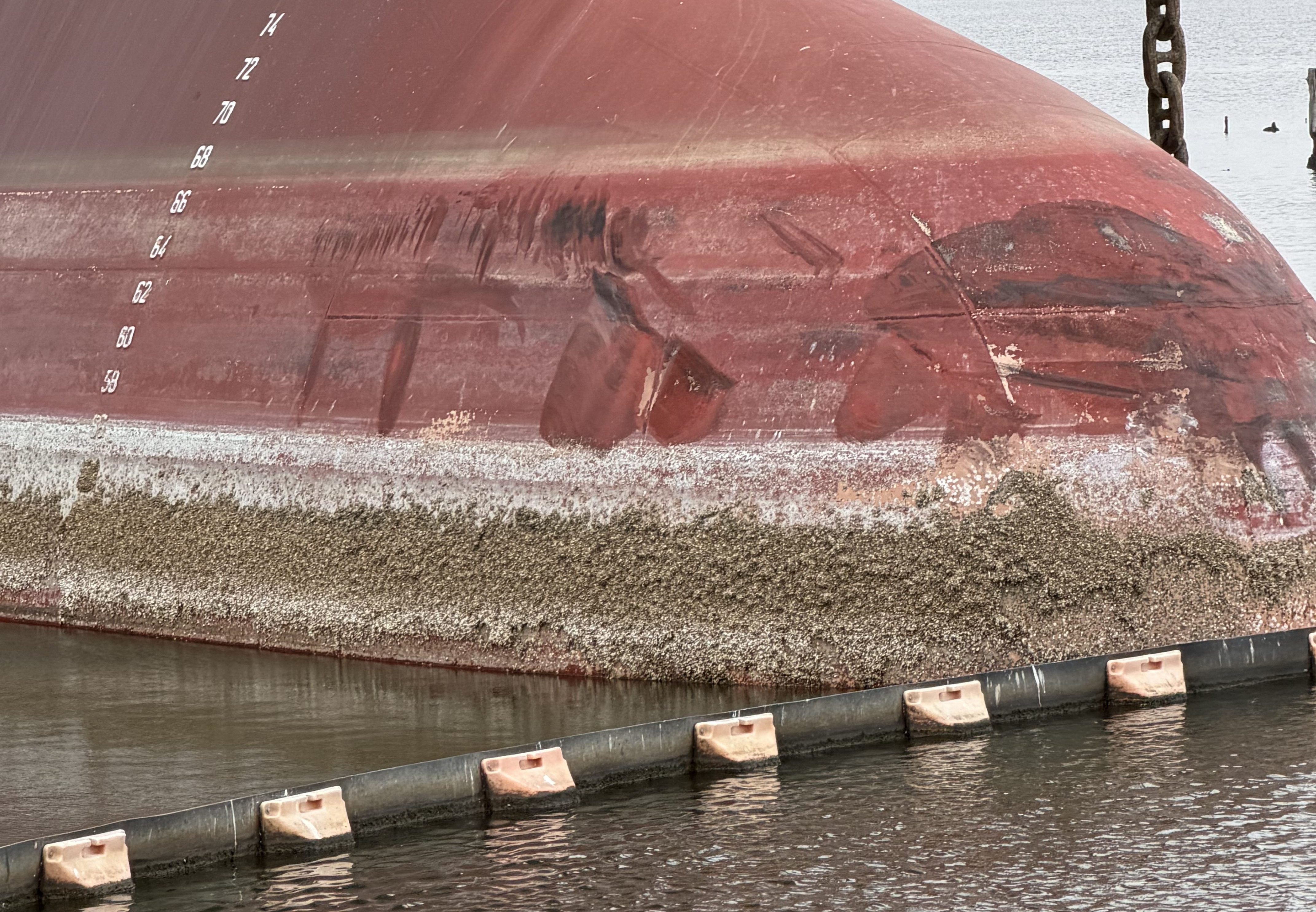
Scientists, shipping regulators, and environmental managers have worked for decades to reduce the risk of spreading invasive non-native species to ports around the world through ships’ ballast water. What’s been less manageable has been on the outside of ships—organisms that grow on ships’ hulls, a condition known as biofouling.
Biofouling has taken on new urgency, however, as hundreds of ships have been stuck in the Persian/Arabian Gulf since the closure of the Strait of Hormuz in February. In a paper published in the journal Biological Invasions in mid-July, an international group of 24 scientists is warning of the potential ecological consequences of the strait’s closure. Laden with organisms after sitting idle for months, these ships will likely become vectors for transfer of non-native species as they resume voyages among ports around the world.
“The unprecedented scale and duration of this spring and summer mass lay-up of large commercial ships has created ideal conditions for a marine invasive species ‘super-spreader’ event,” says lead author Mario Tamburri, a professor at the Chesapeake Biological Laboratory (CBL), part of the University of Maryland Center for Environmental Science (UMCES). “Our goal is to raise awareness of this significant biosecurity risk and provide practical recommendations to help reduce non-native species introductions as these idle ships resume their global operations.”
The paper, “Closure of the Strait of Hormuz May Trigger a Bioinvasion Super-Spreader Event,”
notes that, “More than 1,500 large commercial ships have remained idle in the Persian/Arabian Gulf and the Gulf of Oman…since February 28, 2026. These vessels have arrived with biofouling organisms from a wide range of source regions and are now acquiring (and will likely depart with) extensive biofouling communities of microbes, algae, and invertebrates from the Gulf region. This massive intermingling of ships and biofouling will result in the inevitable release of non-indigenous species (NIS) at the lay-up sites and in the spread of marine species across the globe.”
As of mid-July, the International Maritime Organization (IMO) reported that 300 to 400 ships, staffed by some 6,000 seafarers, still remained stranded. This does not include local trading or working vessels, an IMO spokeswoman said, adding that precise numbers are difficult: “The estimates are based on information we receive directly from industry groups and publicly available ship tracking data, noting that data from all sources are affected by spoofing, ships turning off their AIS [Automatic Identification System], ships moving within the Gulf, so that this is not an exact science.”

Tunicates and bryozoans on a ship hull (Credit: Kim Holzer, Smithsonian Environmental Research Center)
In 2023, the IMO released its Biofouling Guidelines to minimize the transfer of non-native species on ships, after nearly two decades of working with member states on the problem. The IMO is working toward mandatory requirements; a draft legal framework and recommendations aren’t expected until 2029.
“The extent of the problem of invasive species on ships’ underwater surfaces is largely due to the expanded trade and traffic volumes over the last several decades and, since the volumes of seaborne trade continue to increase, the problem may not have reached its peak yet if left unaddressed,” the IMO states. “The effects in many areas of the world have been devastating; quantitative data show that bio-invasions are continuing at an alarming rate and new areas are being invaded all the time.”
A 2024 report from the United Nations’ GESAMP (Group of Experts on the Scientific Aspects of Marine Environmental Protection), of which Tamburri is a member, noted “between 56% and 70% of the currently established coastal and estuarine NIS globally were transported through a biofouling pathway.”
In U.S. waters, shipping is “the dominant vector” for invasive species in coastal and estuarine systems, says Gregory Ruiz, a co-author on the new paper and a senior scientist at the Smithsonian Environmental Research Center’s (SERC) Marine Invasions Research Lab. Over decades of monitoring, researchers have identified some 540 non-native species of invertebrates and algae in U.S. waters, Ruiz says. Analysis has shown that about 80% of these likely arrived via either ballast water or biofouling on ships. Although they overlap as sources (some species can live on the hull as adults and as larvae in ballast water), over half-are linked to biofouling, he says.
A Sea of Hitchhikers
Ships, boats, docks, oil platforms, inlet pipes for power plants—all are potential places for biofouling. The first colonizers are microorganisms—bacteria and microalgae—that form what’s called a slime layer. Then larger organisms settle, from nematodes and ostracods to larger macroalgae and invertebrates (like sponges, tubeworms, and bivalves), creating an entire community that can include mobile and stationary species (barnacles are a well-known example of the latter).
Antifouling coatings or paints are applied to ships’ submerged surfaces and work best to limit growth when commercial vessels are underway, with short turnarounds in ports. In-water cleaning by divers or ROVs also helps limit this growth on ships. But as ships sit idle, particularly in warm productive waters, organisms grow quickly.

A diver operating a Remora Hull Cleaning Vehicle with reclaim.
(Credit: Subsea Global Solutions, LLC)
“Sea surface temperatures in the [Arabian] Gulf frequently exceed 30°C [86°F] during summer months, creating ideal conditions for rapid marine growth,” says Cleanship, a United Arab Emirates-based in-water cleaning business. “A vessel calling at Jebel Ali or Rashid Port in Dubai can accumulate significant sea chest fouling within a single port call,” (a couple of days).
Fouled sea chests—underwater inlets that take in seawater for purposes such as ballast, firefighting, and cooling—can cause engines to overheat and other systems to fail, creating a safety hazard for ships. By slowing a ship’s speed through the water, requiring more fuel to move, biofouling also contributes to global fossil fuel emissions and costs ship owners money.
The Strait of Hormuz is the only route for ships traveling from the Persian/Arabian Gulf to the Arabian Sea, Indian Ocean and world trade routes. About 30,000 commercial vessels annually transit the strait, including cargo ships and oil tankers.

A map of the Strait of Hormuz and surrounding areas. (Credit: UMCES Integration and Application Network)
“The majority of vessels in this region spend 1 to 3 days in port before departing,” the new paper notes. “However, at the time of writing, ships in the Gulf region have remained idle there for at least 40 times longer than an average stay.”
The paper notes that summer sea surface temperatures in the Persian and Arabian Gulf region can reach 38°C [100°F], with salinities exceeding 40 psu. Extreme environmental conditions, as well as coastal industrialization and urbanization, have already taken a toll on biodiversity in these waters. That’s significant, Tamburri says, because the species that remain are extremely tolerant.
“When you’re a really hardy organism, that makes you a prime invader candidate,” he says. “Worrisome types of organisms are the potentially destructive macrofouling, like seaweeds, mollusks, and barnacles. Some of these may be particularly hardy and opportunistic because they live in extreme conditions like hot, salty water.”
Seasonal warm temperatures also spur reproduction in many species. “Given the high densities of fouling organisms that can occur on ship hulls and niche areas (e.g., sea chests, rudders, and piping systems), individual vessels may have released millions of larvae during this lay-up period,” the report says. “The proximity of idle vessels provides abundant settlement substrate for these propagules, while the eventual resumption of shipping will facilitate their widespread dispersal.”
An example of an aggressive invader noted by the IMO is the colonial tunicate Didemnum vexillum. Native to the northwest Pacific Ocean, it has spread to New Zealand, the northeast and northwest Atlantic, and northeast Pacific. “This species…is able to reproduce sexually or asexually,” the IMO notes. “Fragments of the species are able to disperse, reproduce, reattach and thrive. This species fouls hydrotechnical constructions, ships, aquaculture infrastructure and cultured molluscs. It affects the biodiversity of existing communities as it outcompetes for habitat or simply grows over or smothers existing species.”

Didemnum vexillum, a colonial tunicate known to foul ship hulls, sea life and other surfaces. (Credit: Ian Davidson)
Another is the black-striped mussel (Mytilopsis sallei) native to the northwest Atlantic, Caribbean and south Atlantic. Now spread to India, Malaysia, Singapore, the south Pacific, and northwest Pacific (Japan, China), it “tolerates wide fluctuations of salinity and temperature. Highly fecund, grows and reaches maturity rapidly,” the IMO says. “This species is capable of forming dense aggregations, impacting biodiversity as they exclude most other species.”
Tamburri, who has been working at UMCES on the issue of invasive species in ballast water and biofouling for 25 years, says a local example on the Bay is the rope grass hydroid Garveia fransiscana (also known as Calyptospadix cerulea), “native to the Indo-Pacific and an invasive species in the Chesapeake Bay that was introduced here by commercial ship biofouling about 100 years ago. It has serious impacts on local habitats and industries, including biofouling of power plant cooling systems. We have done extensive work with Calvert Cliffs Nuclear Power Plant to find safe and effective hydroid antifouling solutions.”
He doesn’t expect the situation in the Strait of Hormuz to directly affect a port such as Baltimore, where the low salinity local waters would likely not support species coming from such high salinities in the Persian/Arabian Gulf. “So we’re going to be looking at high salinity locations. Where we start is the region nearby, so the Mediterranean and most of Asia.”
Ruiz says he hasn’t specifically studied what the Bay’s environmental conditions would mean for species coming from that region, but he wouldn’t rule out ports near the Bay’s mouth, which are far saltier than those farther north, eventually being affected.
“I’m not convinced that’s true for the Norfolk, Hampton Roads area,” he says. “The thermal regime is quite different here, but some non-native species have very wide tolerance. They’re known to be generalists, which is part of the reason they’re so successful and occupy lots of different global regions.”
Mitigating the Risk
The ships that have been sitting idle for months ideally would be cleaned before moving. In-water cleaning (IWC) is a common practice to clear ships of biofouling, and in fact Bloomberg reported in mid-June that requests for the service had jumped 30-fold when talks of reopening the strait were making progress. But it’s unlikely most ships will be cleaned before leaving, the report notes, because the priority will be on exiting as quickly as possible, when possible.

A Cleaning Remotely Operated Vehicle (C-ROV) with reclaim operating at night. (Credit: Subsea Global Solutions, LLC)
“There is limited capacity there to handle that many ships,” Tamburri says. “Most in-water cleaning only happens occasionally, often during cargo operations. There’s no way they will have enough capacity to clean all of them.” And, he adds, “Even if everyone has the best intentions, sometimes it’s just not safe to get cleaned before you leave.”
Karl Lander, environmental services director for Subsea Global Solutions, which operates cleaning services around the world, adds that ships likely will have to leave the gulf “to get significant cleaning services. There are services in the gulf, a few ships can get cleaned there, but the capacity doesn’t exist there. And much of the capacity that is there doesn’t have the filtration to catch the material.”
Catching the material—using systems that ensure that what comes off the ships doesn’t just get dumped back into the water—is the ideal scenario for in-water cleaning, but it’s not the norm, he says. Only about a dozen such systems are being used worldwide; he estimates about 98% of what’s cleaned off of hulls is not captured. That matters in this situation particularly, since many of the ships likely arrived with organisms from other regions, and they have had time to grow.
And while the big, smooth parts of hulls are time consuming to clean, Lander says, it takes days to thoroughly clean all of the niche areas, like sea chests.
To help mitigate the risk, the authors recommend estimating the level and extent of biofouling, even if just at a ship’s waterline, and providing even general assessments about the magnitude of organisms present. “Documentation of underway ship power loss (due to increased biofouling drag), especially when compared to these metrics from before the lay-up, can be a useful proxy for the relative amount of biofouling on the submerged surfaces and corresponding biosecurity risk,” the authors said.
Also, they recommended that high-risk ports nearby establish early detection methods, including settlement plates, and that biosecurity warnings be communicated quickly to all stakeholders, “including port authorities, shipping operators, environmental agencies, IWC service providers, and regional biosecurity networks. Identifying trusted knowledge brokers across global recipient regions (e.g., Mediterranean, SW Atlantic, North Atlantic, Pacific, and Indian Oceans) will be essential to ensure that NIS warnings are translated rapidly into operational guidance, coordinated preparedness, targeted monitoring, and risk-reduction actions.”
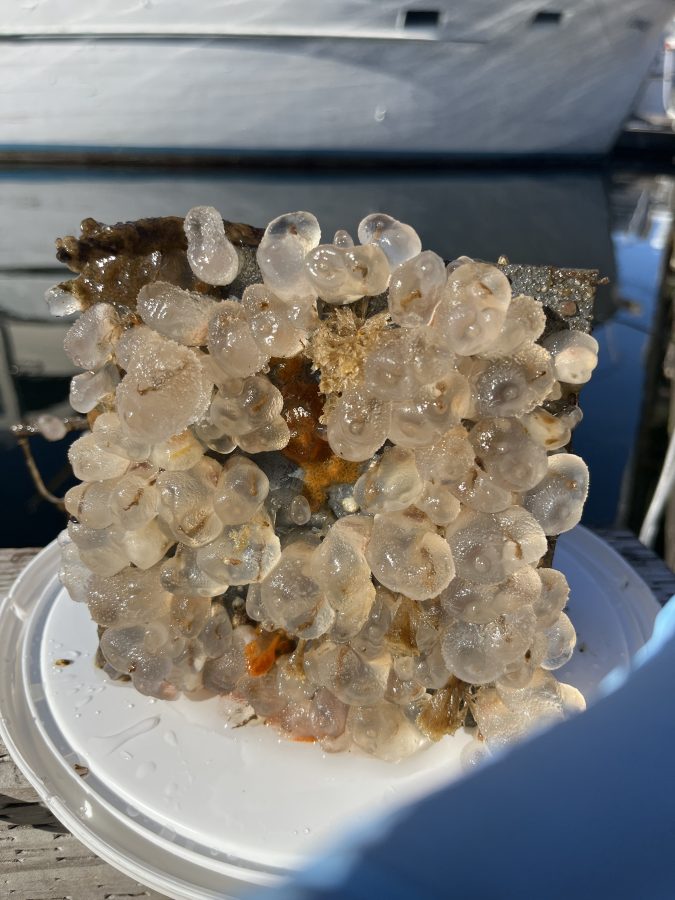
Settlement plate set out by SERC’s Marine Invasions Lab to monitor for invasive species in Ketchikan, Alaska. (Credit: Jessika de Jesus, Smithsonian Environmental Research Center)
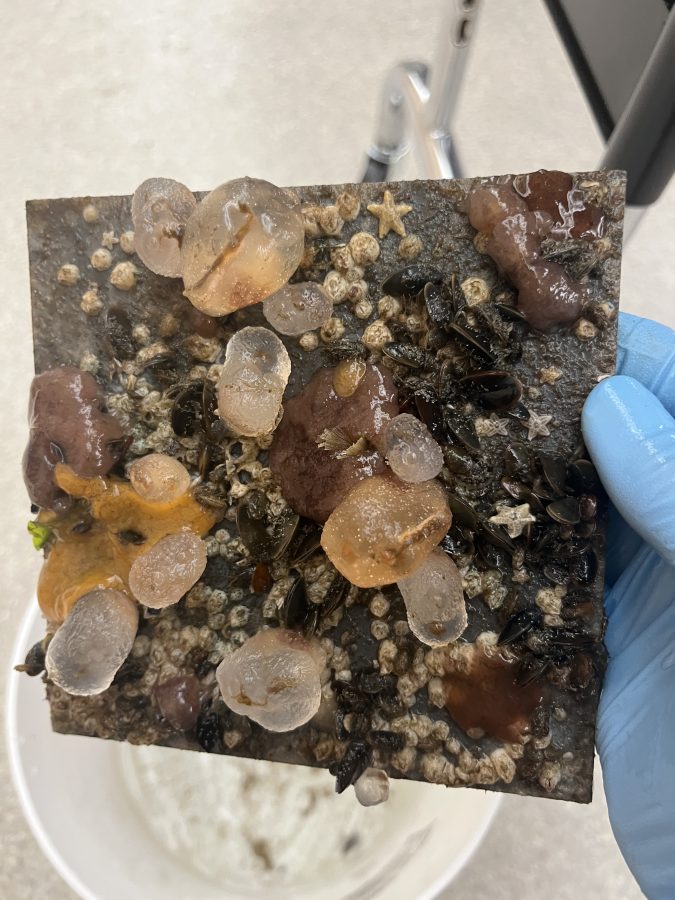
Settlement plate set out by SERC’s Marine Invasions Lab to monitor for invasive species in Ketchikan, Alaska. (Credit: Jessika de Jesus, Smithsonian Environmental Research Center)
Tamburri and Ruiz say this paper’s goal is primarily to raise an urgent alert about the elevated risk of marine biological invasions coming from vessel lay-ups in the Strait of Hormuz. Going forward, the authors will collaborate on in-depth research and modeling of ship routes, individual vessels and probability of fouling, and species’ tolerance to survive transit, then relocation and their ability to reproduce. Such information can be used to build models that can determine the highest-risk ports based on data including temperature changes, salinity changes, and types and characteristics of organisms. A goal would be to provide details on how and where to establish monitoring networks to try to catch an invasion before it happens.
“I think we’re going go into a deeper level of analysis of what’s the risk exposure for these vessels,” Ruiz says. “That is going to take us a while to get at that, to have a more granular understanding of what’s the potential exposure, including where potential hot spots exist for species to show up.”
Wendy Mitman Clarke is a science writer and sailor based on Maryland’s Eastern Shore. Find more of her work at wendymitmanclarke.com.