Steering Out of Crashes
UMCES researchers are part of a new national effort to understand what causes larval die-offs—called crashes—at bivalve hatcheries.
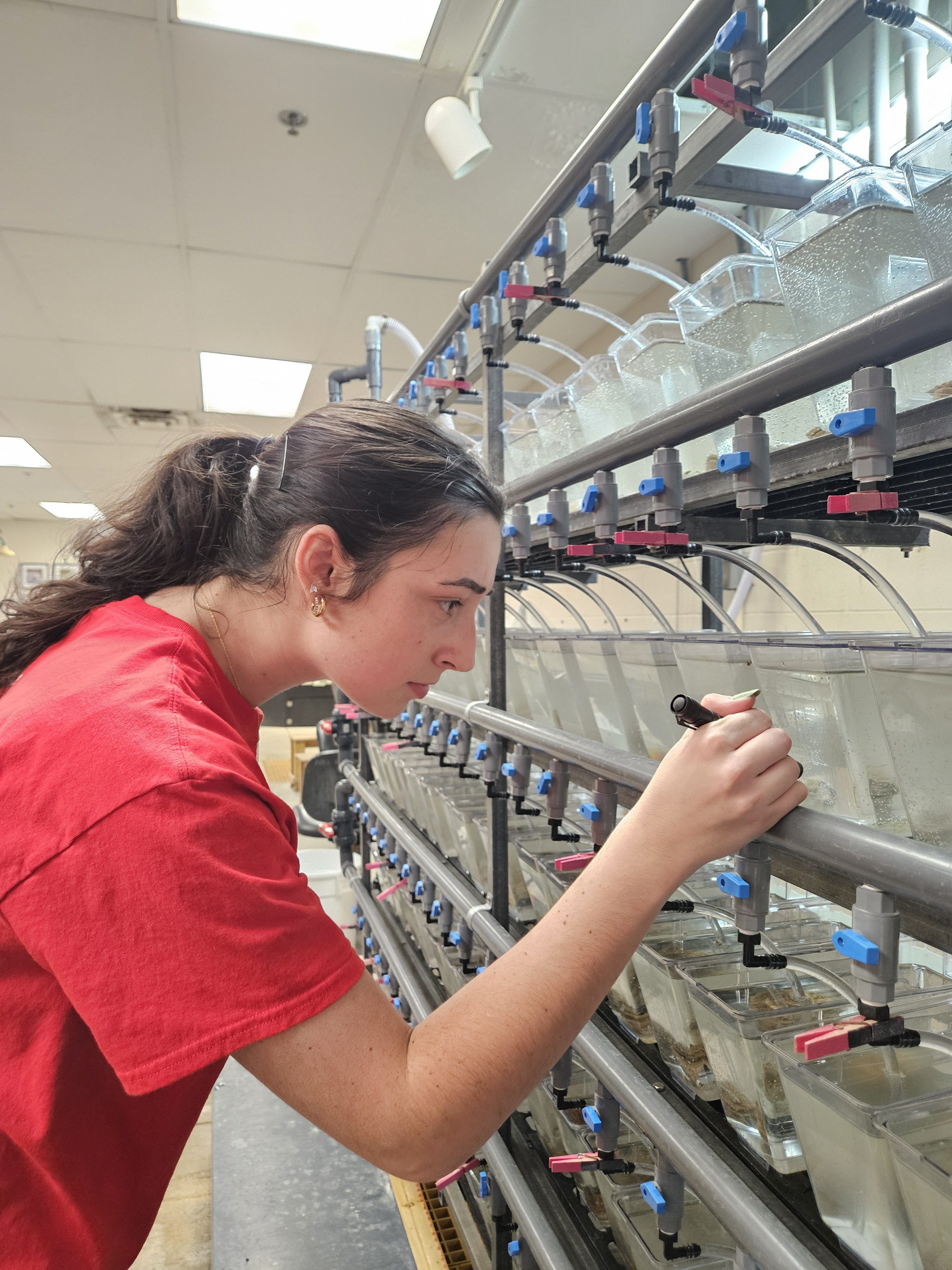
By Wendy Mitman Clarke. Featured image courtesy of Stephanie Alexander.
In 2023, the University of Maryland Center for Environmental Science’s Horn Point Oyster Hatchery had a banner year. Salinity in the Choptank River, where the hatchery is located, was ideal, “the brood stock was super happy, we were producing a billion eggs per spawn,” says Stephanie Alexander, the hatchery’s director and manager. “We were getting 25% of egg to spat, which is huge.”
And yet, in late July into early August, the hatchery suffered a crash—an event that happens at some point every year when tens of millions of oyster larvae die, within hours. It wasn’t nearly as bad as previous years, in particular 2019, when repeated crashes stopped production for nearly two-thirds of the hatchery’s growing season. In 2023, the hatchery bounced right back and finished the season with record numbers.
But the seemingly intractable problem of crashes, which plagues hatcheries everywhere, remains a looming threat to the business of shellfish aquaculture and, in Maryland particularly, to oyster restoration. Now, UMCES researchers who are part of an East Coast group of scientists and industry members wrestling the problem since 2023—the Bivalve Hatchery Health Consortium (BHHC)—are helping lead a new national effort thanks to a three-year, $800,000 grant from the U.S. Department of Agriculture.

Oyster larvae beginning to grow on a recycled oyster shell. Photo courtesy of Stephanie Alexander.
The new grant will enable the expansion of sample and data gathering to hatcheries on the Pacific and Gulf coasts, as well as Hawaii. It will support collaborative science to try to solve some of the factors contributing to crashes, with a goal to providing guidance and best practices to avoid them. This broad effort is needed because crashes happen in hatcheries everywhere, regardless of geography, water sources, season, and size, says Matt Gray, an associate professor at Horn Point Laboratory (HPL) who studies ecophysiology of bivalves.
“Hatchery crashes in general are just a well acknowledged, persistent problem in the industry, but it has, to date, seemed like such an insurmountable problem that everyone reluctantly accepted,” Gray says. “But at the same time, can you imagine an industry or factory that randomly can’t make their widgets for months on end? Would that ever be acceptable? So, if we really want to make the industry grow, be sustainable, we’ve got to get beyond this mentality that we can’t improve things. We’ve got to tackle it.”
Multiple causes are likely, varying over geography and season, he says, and it may not be possible to identify them all. “But it would be monumental if we get through this project and we develop the tools, so that way, whatever problems pop up, we can identify them.”

Hatchery spawning tanks. Photo courtesy of Stephanie Alexander.
Marta Gomez-Chiarri, a University of Rhode Island professor specializing in aquatic pathology and coordinator for the BHHC, says the new grant is an acknowledgment of the importance of bivalve aquaculture, widespread industry support for this work, and the data-gathering groundwork the BHHC has laid over the last three years, operating under a pair of $300,000 grants from the Northeast Regional Aquaculture Center (NRAC).
“The beauty of this grant is that we have both research hatcheries and commercial hatcheries enrolled, so we can use the research hatcheries to do the testing and the publications and showcase data. But we can also get the data from the commercial hatcheries, and aggregate it and keep it anonymous,” she says. “We have a really collaborative approach that includes many different states and the top scientists working on this area. So I think it’s a combination of good science addressing a very important need of the industry.”
Crash Dynamics
Horn Point Oyster Hatchery produces billions of oyster larvae between April and September annually, making it the largest supplier on the Atlantic coast to commercial aquaculturists and to support restoration projects. It is an intensely precise, complex, demanding business, harnessing a natural process and attempting to maximize it while controlling as many variables as possible. Crashes flush all that precision down the drain, stopping production for weeks or months.
“Unfortunately, there are no signs, because if there were, we would pay attention to them and then mitigate whatever was coming,” Alexander says. “Sometimes it happens just in one tank, and we dump it and move on. Sometimes it’s hatchery wide.” In their usual water changes two to three times a week, hatchery staff will drain a tank and monitor larvae. “The days we have crashes, we’ll start draining the tanks, and we won’t see a lot on our sieves…uh oh, last drain, they were fine. Three days ago, they were fine. Today, not looking so good. So when we do a count, and they’re all sitting dead on the bottom of the tank, it’s a crash.”
In 2019, a prolonged wet winter and spring lowered salinity levels in the Choptank River, which the hatchery uses to flow over their brood stock oysters and replace larval tank water, to 5 ppt, for nine months (for comparison, the summer of 2026 salinity was 14 ppt). Algae, which oysters eat, wasn’t abundant in the river. Hatchery staff anticipated problems and tried to head them off—experimenting with a recirculating system for some of the brood stock in which they could control salt and algae content—but the spawn was feeble and larvae were not thriving.
“We started playing with different water treatments, filtration,” Alexander says. “Is there something bad in the water that’s preventing the larvae from growing? So that’s when we started UV, diatomaceous earth, charcoal water, ozone water, you name it, we were throwing the kitchen sink at it. And nothing really seemed to help. We probably worked harder in 2019 than we did in one of our record years…and we didn’t have a lot to show for it, which was extremely frustrating.”
Ultimately, the hatchery was only able to produce larvae for about a third of the season. A 2022 paper led by Gray with UMCES co-authors Alexander, Jacob Cram, Patricia Gilbert, Klaus Hubert, and Louis Plough from HPL, Michael Gonsier, Lisa Wainger, and Vyacheslav Lyubchich from Chesapeake Biological Laboratory (CBL), and Eric Schott from the Institute of Marine and Environmental Technology (IMET), examined the 2019 crashes and possible causes. They noted that for eight weeks (late May to late July), “complete production failure was observed…The hatchery staff conducted 8 larval developmental assays and other water quality analyses to identify drivers of production failure.”
The paper noted that harmful algal blooms (HABs) have been suspected, as well as harmful bacteria, organic pollutants (such as pesticides, herbicides, and runoff from agricultural sources), poor water quality, and low salinity—especially given the hatchery’s location in the mesohaline part of the river, where salinity ranges from 5 to 18 ppt. “Although production failure was linked to historic rainfall and low salinity conditions for months preceding the 2019 season…no clear causes or factors have yet been identified to explain the prolonged crashes in 2019.”
Not only do crashes cost hatcheries time and money (the paper estimated a single tank crash at Horn Point can cost $24,000 in lost revenue, excluding extra labor and production costs), their effects ripple outward into the aquaculture industry.
“The ‘Seed Crisis’—observed in the western USA oyster industry is a notable example,” the authors noted. “During the late 2000s, commercial hatcheries struggled to produce oyster larvae for years, which ultimately resulted in an estimated industry loss of $110 million in the Pacific Northwest…Although crashes in shellfish hatcheries are acknowledged to occur and considered common, they also represent one of the unspoken failures in current shellfish cultivation. Crashes remain under-investigated.”

Students and staff at work in the hatchery. Photo courtesy of Stephanie Alexander.
Casting a Wider Net
In their proposal to the USDA, Gomez-Chiarri, Gray and other members of the BHHC who have been working with private and public hatcheries on the East Coast outlined the scope of the problem just in this region.
“During the 2024 and 2025 production seasons, we have collected samples and data from 70 production runs at 33 different hatcheries, focusing on the Atlantic coast of the US based on the funding available. Sampling covered four different bivalve species (mainly eastern oysters, but also northern quahogs, bay scallops, and mussels). In 2024, 55% of the 33 production runs were crashes or showed low larval performance, with 54% of 37 production runs reporting crashes in 2025.”
The new USDA grant will enable researchers to dramatically expand this data gathering. “Samples and metadata will be collected through a standardized, collaborative approach from productive and unproductive larval production runs from at least 75% of the hatcheries in the US to allow for data mining of both global and regional factors affecting larval production. A comprehensive battery of diagnostic tests will be applied to those samples,” the grant proposal noted.
Scientists will approach the data from multiple perspectives, using data mining and hypothesis-driven assays to identify and confirm potential causes, whether from environmental or husbandry factors. They’ll use that information to develop management tools, then test those tools at hatcheries in different geographical regions and for different bivalve species.
“Every scientist is going to focus on the thing that they do well, and then we’re going to apply it to lots and lots of samples. And then we have the giant logistical challenge of trying to fit all that data together into a useful story,” says Jacob Cram, an assistant professor at HPL focusing on microbial ecology. “It’s a really impressive amount of partners that have different kinds of hatcheries, possibly different kinds of problems. We’ll see if there are any overarching kinds of things. I’ll look at the microbial community on all these samples and say, what microbes and what kinds of bacteria that are in and on the larvae relate to crashes?”
“He can go in and use genetics and understand the different bacterial, viral, and other microorganisms, see who’s in the water under both good and bad production scenarios,” Gray says. “That’s a ton of data that he gets to now work through. So that’s huge.”

Oyster setting tanks at sunrise. Photo courtesy of Stephanie Alexander.
At Horn Point, Cram has already been working with Alexander and the staff to better understand crashes. In 2021, he asked them to start keeping larvae samples from every water change, which he then freezes.
“He basically has six years of our hatchery health history, if you will, in his freezer,” Alexander says. “However, he hasn’t had the money to run all the samples.” With a separate USDA grant that’s related to the new BHHC grant, Cram will be able to run this backlog of samples.
“That’s going to include the good runs, the meh runs, the poor runs, as well as the crashes,” Alexander says. “And hopefully, there’s going to be a smoking gun that we can then kind of be on the lookout for.”
Alexander believes more than one factor drives crashes. But before hatchery managers can know how to respond, they need more information. “There are different ways to mitigate, but we don’t know what we’re trying to mitigate around. So I’m hoping that all his samples are going to paint a picture for us.”

Eyed oyster larvae. Photo courtesy of Stephanie Alexander.
Cram also this year won Maryland Sea Grant funding to study whether hatchery source water drives crash events and to identify signals in source water that either predict or cause crashes. Leveraging weekly microbial DNA sampling data gathered at Horn Point since 2023, researchers will also collect weekly water source samples at Horn Point and Morgan State University’s Patuxent Environmental Aquatic and Research Laboratory (PEARL). They will measure water quality parameters, microbial composition, and viral populations and relate these to hatchery larval health. Data from both locations will help identify correlations, and machine learning will be used to identify whether microbial and environmental compositions can predict crashes and determine causes. Ultimately, the research will inform hatchery design, especially related to water filtration, help develop affordable methods to test for crash triggers, and provide hatchery managers information on how best to prevent crashes.
Cram says that when Gray and the UMCES team authored the 2022 paper, the gist was: “Here’s this problem. We don’t really know what’s happening. We’d like to do all of these things. There’s no money for it…Now we’re really ramping it up. It’s really exciting.”
“Decades ago, we really didn’t have the tools that we needed. So maybe the time is now that we’re actually able to make a dent,” Gray says. “The biggest ones are genetic and genomic tools. Using DNA extraction techniques, we can see who’s in the water, whereas before they were invisible.”
Even in terms of the data gathering, Cram says, “It’s way more samples than anybody’s collected before, and the number of measurements, and the sophistication of the measurements that we’re taking is really high…I think, between these projects, we’re really in a strong position to get some insight into what’s happening.”
For her part, Alexander says she’s looking forward to having more tools to help navigate the inevitable uncertainties of trying to manage nature.
“At the end of the day, we need to be producing oysters. So our job is to walk in the hatchery every day, see what Mother Nature is throwing at us, react to it, and figure out a way to get larvae out the pipeline,” she says. “Sometimes we’re very successful. Other times, not so successful. And I wish it was a little bit more even.”
Wendy Mitman Clarke is a science writer and sailor who lives on Maryland’s Eastern Shore. See more of her work at wendymitmanclarke.com.