Anthropogenic Changes in Estuarine Systems (ACES) Center
Background & History
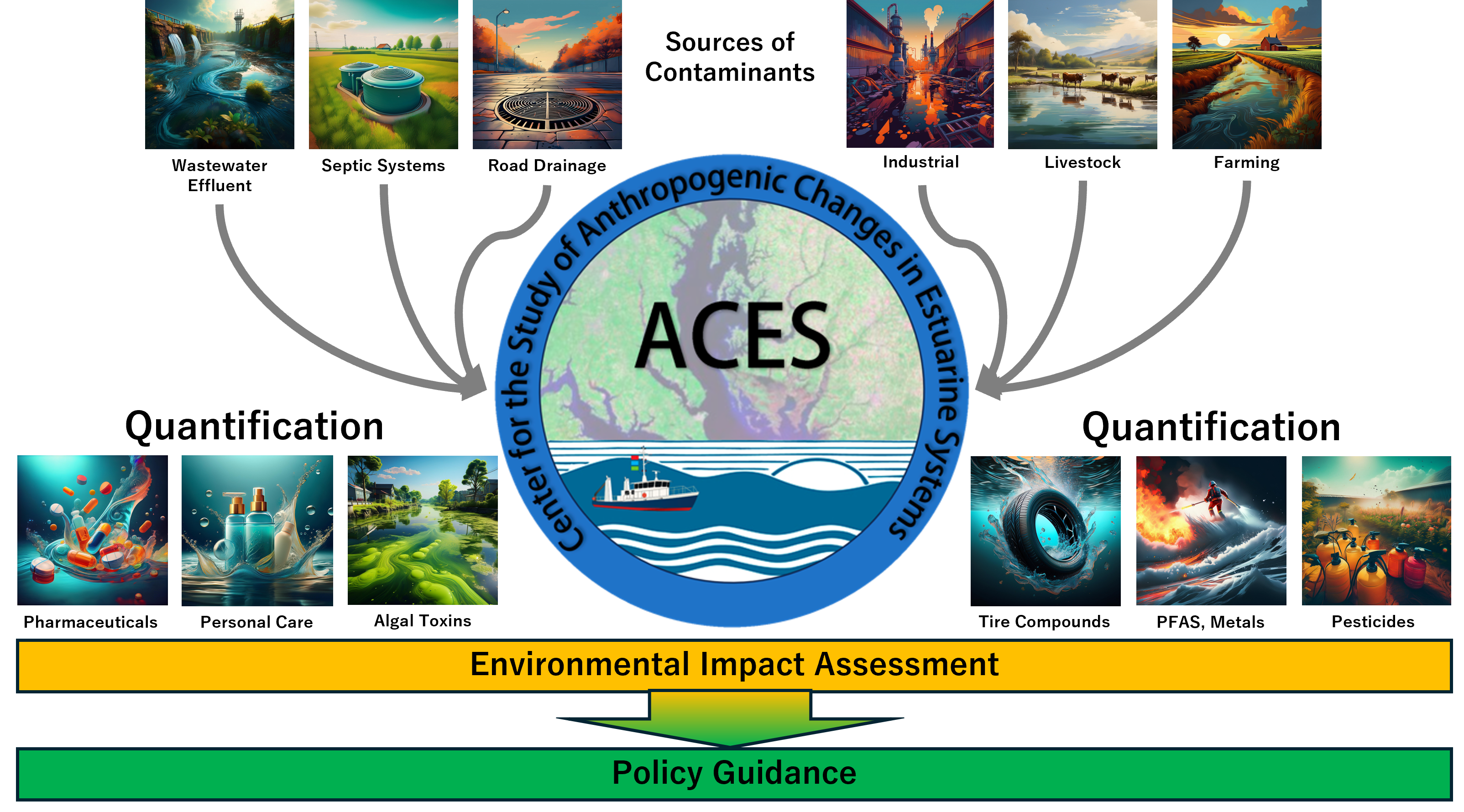
 Recognizing the Laboratory’s long-standing tradition of investigating chemicals of environmental concern, the Center for the Study of Anthropogenic Changes in Estuarine Systems (ACES) supports the development of analytical methods to help UMCES scientists identify and quantify the diverse array of anthropogenic chemical changes present in the environment. This information is used by a number of stakeholders, including managers and legislators to identify chemical contaminants of emerging concern and assess their potential risk to environmental and human health. Data are also used to follow the effectiveness of restoration activities and identify sources of contamination to provide pollution reduction solutions.
The Center was established in 2022 thanks to a kind donation from Brian Hochheimer and Marjorie Wax and support from CBL’s Director at the time, Dr. Tom Miller. Two state-of-the-art hybrid mass spectrometry systems, purchased using these funds, greatly expanded our explorable chemical space. The Center also contains a number of other analytical instruments to measure inorganic (e.g., trace and heavy metals) and organic environmental components or contaminants. Current routine analyses are listed in the analytical capabilities section. The Center is also open to developing methods/techniques for new target analytes in collaborative research proposals and/or fee-for-service arrangements.
Vision
The ACES Center is transformative for UMCES scientists’ research programs and providing state-of-the-art training for our next generation of environmental scientists. A number of students across USM campuses are currently being trained in the ACES center and generating research data for their graduate projects. We envision that we will be able to offer formal graduate level courses, workforce development training and certificate programs in these techniques in the near future.
We also conduct sample analyses for a variety of stakeholders: collaborating scientists, state and federal agencies, private sector and NGOs, amongst others.
ACES aids UMCES’ mission to support Maryland’s state and local governments in addressing our understanding of legacy and emerging contaminants of concern in the environment, developing solutions to pollution issues and elevating our message to the world stage.
Instrumentation
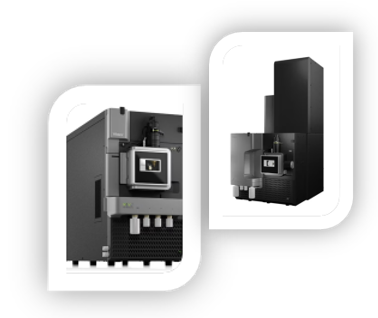
Instruments at ACES include Waters Xevo G3 Qtof and Xevo TQ Absolute mass spectrometry systems. Also available at CBL through ACES scientists are: Thermo Orbitrap XL LC/MS, Agilent 6420 LC-MS/MS, Agilent 5975 GC/MS, Agilent 7500 ICP/MS and Agilent 8900 LC-ICP-MS/MS systems.
Analytical capabilities
We have a number of currently available analytical methods to detect individual and suites of chemical contaminants in environmental matrices (e.g. water, sediment, biota). Contaminant examples include PFOS/PFOA, various UV filters (often associated with cosmetics and sunscreens), wastewater effluent/septic system tracers (e.g. sucralose, caffeine, acetaminophen, carbamazepine), tire compounds (6-PPD and 6-PPDQ), polycyclic aromatic hydrocarbons (PAHs), organic mercury, algal toxins and various trace and heavy metals. Methods can also be developed as requested to investigate other anthropogenic environmental changes.
ACES scientists possess extensive experience in analytical methods/techniques and instrumentation, toxicology, imaging and -omics, and several other scientific disciplines. We would love to talk to you about how we can collaborate or strengthen your research findings. Please direct any questions to the general information email (ACES@umces.edu).