Science and Story
For one UMCES graduate student, studying a species like horseshoe crabs goes hand in hand with telling their story.
By Wendy Mitman Clarke. Featured image courtesy of J. Sook Chung.
Jessica Baniak had already learned she loved working in aquaculture with what could be termed dubiously charismatic fauna—soft clams and oysters—when she learned about the research of Sook Chung, professor at the Institute of Marine and Environmental Science (IMET), and really started getting to know the unsung wonder of the horseshoe crab.
“I was like, oh, of course horseshoe crabs are neat. I don’t know too much about them, however, they’re really cool,” Baniak says. “But the more I learned about them, the more I learned this is a niche creature that’s really hurting right now. And there’s just such a complicated story around them that I had no idea about. And if I can share even a little bit of this story with each person I reach out to, then they’re going to care.”

Jessica’s tabling setup for a STEM Unbound event at IMET. Photo courtesy of Jessica Baniak.
That complicated story is wrapped around a creature that has remained unchanged for some 450 million years, often termed a “living fossil.” The horseshoe crab (Limulus polyphemus) is remarkable for a multitude of reasons—not least because its blood is capable of detecting certain bacteria endotoxins with uniquely fine sensitivity. Because of this, its blood is harvested through a tightly regulated biomedical industry for Limulus amebocyte lysate (LAL), which is used to test a huge array of medical products, from vaccines to implanted devices.
They are also a key player in an ancient relationship with certain migratory birds, most notably the red knot (Calidris canutus rufa), listed as threatened under the U.S. Endangered Species Act. Every spring, this robin-sized bird travels 9,000 miles from Tierra del Fuego to the Arctic, and a critical rest stop along its route is Delaware Bay. Here, it encounters the largest population of horseshoe crabs in the world—an estimated 16 million adult females and 40 million males as of 2024, according to the Atlantic States Marine Fisheries Commission (ASMFC). Every spring, these crabs come ashore under the full moon to spawn, and the eggs planted on the beach are a vital food source for the migrating red knots and other species.
Over time, horseshoe crabs have been harvested to be dried and used as fertilizer, and more recently used as bait in the whelk and eel fisheries. Essentially unregulated for decades, this fishery expanded enormously in the 1990s. Both fisheries managers and bird conservationists were concerned that the crabs were being overfished and this was affecting the already stressed red knot population.
“From 1990 through 1997, reported coastwide landings of horseshoe crabs increased from approximately 454,000 kg to over 2.7 million kg, much of which came from the Delaware Bay region,” notes a 2025 paper published in Marine and Coastal Fisheries led by John A. Sweka of the U.S. Fish and Wildlife Service. “The increasing harvest of horseshoe crabs in the 1990s coincided with a decline in their abundance and counts of shorebirds, particularly the red knot, during their stopover in Delaware Bay. Aerial counts of red knots declined from approximately 50,000 birds in the late 1990s to an average of 25,000 between 2012 and 2018. The ASMFC adopted the first interstate fishery management plan for horseshoe crabs in 1998 in efforts to conserve horseshoe crabs and the shorebirds that depend upon their eggs for food during the stopover period.”

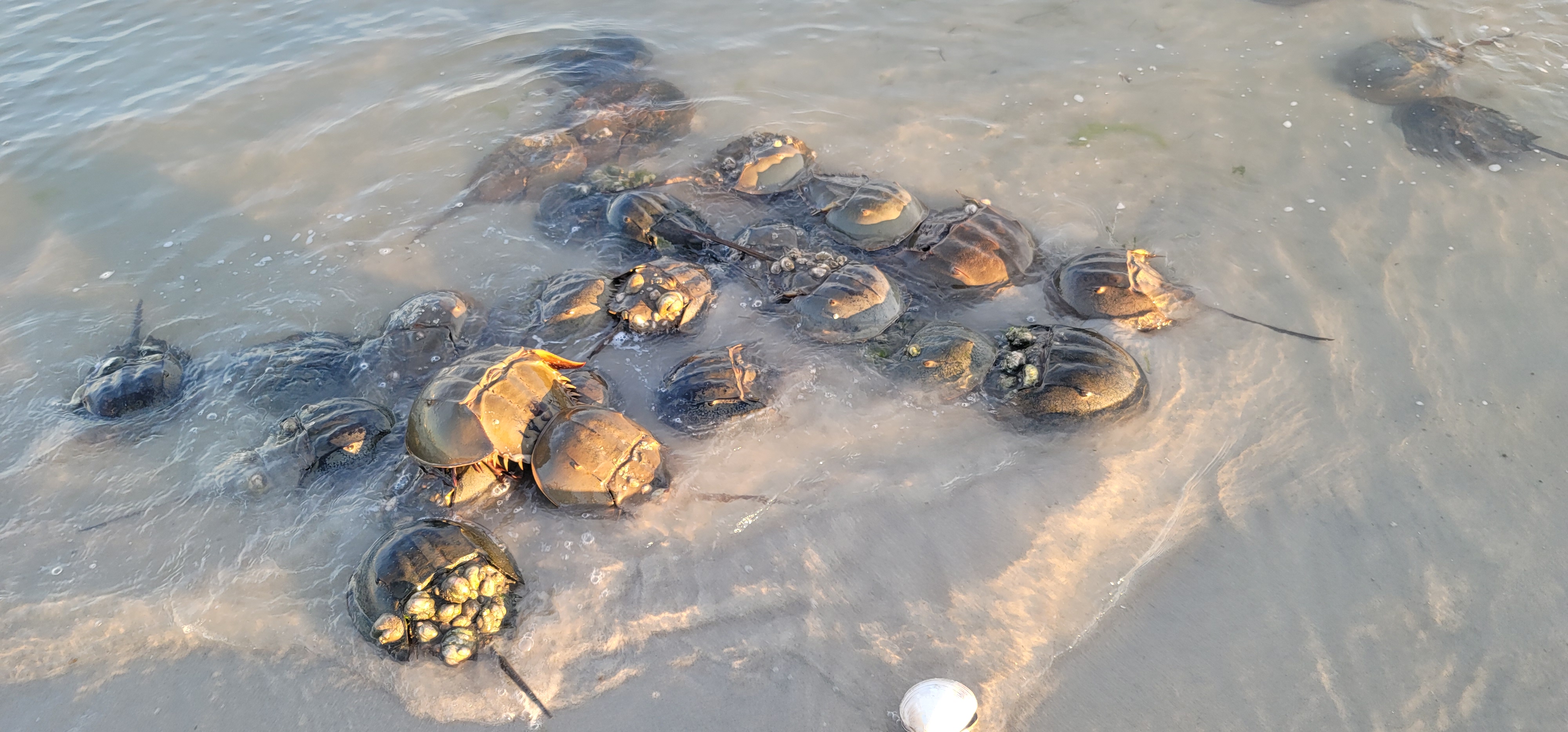
Horseshoe crabs spawning in Delaware Bay. Photo courtesy of J. Sook Chung.
Since 1998, Delaware has permitted only harvest of males, and since 2008, New Jersey has placed a moratorium on all horseshoe crab harvest. The 2025 paper, “Recovery of Delaware Bay horseshoe crabs following harvest reductions,” notes that fisheries-independent surveys and modeling have determined that the crabs’ Delaware Bay population is stabilizing: “In response to harvest restrictions, the abundance of horseshoe crabs has neared levels observed in the early 1990s—a period prior to high commercial use and a decline in both horseshoe crabs and shorebirds that depend on them for food during annual migrations.”
The same paper noted, however, that habitat loss continues to be a major factor in the depletion of horseshoe crabs, as beaches and shoreline are developed and made inaccessible for spawning.
“Continued population monitoring and regulation of harvest could ensure that use of the horseshoe crabs as bait does not once again result in declining abundance in the region,” the 2025 paper notes. “However, the long-term threat to high horseshoe crab abundance in Delaware Bay may be loss of quality spawning habitat.”
Many still feel the population remains in danger. Earlier this year, the Center for Biological Diversity sued the National Marine Fisheries Service for “failing to make a preliminary decision on whether to protect American horseshoe crabs under the Endangered Species Act.” In 2024, the center and 25 other groups petitioned the NMFS to protect the crabs, saying that populations “have crashed by more than 70% in recent decades because of overharvesting and habitat loss.”
Population recovery is also challenged by the fact that horseshoe crabs, which can live to about 20 years, only reach sexual maturity at about 9 or 10 years old, says Sook Chung, the IMET professor who studies molting, growth, reproduction, and other aspects of crustacean physiology. (For the record, horseshoe crabs are not crustaceans; they are actually chelicerates, more closely related to spiders than crabs).
“So if reaching sexual maturity is that long, and then when you have population issues, it will take that much or longer time to recover the population levels,” Chung says. One aspect of her research is asking, “is there any way we can accelerate their growth to reaching sexual maturity, maybe four years or five years? That’s the drive of my research.”

Baby horseshoe crabs in the classroom. Photo courtesy of Stephanie Tuckfield.
While earning her undergraduate degree in biological science at UMBC, Baniak was participating in an aquaculture internship at PEARL (Patuxent Environmental and Aquatic Research Library) when the lab’s head connected her with Chung and her work at IMET. Ultimately this led to Baniak’s graduate work in Chung’s lab. (She graduated in 2025 with a master’s degree in marine science.)
Baniak was working through UMBC’s ICARE (Interdisciplinary Consortium for Applied Research in the Environment), which links researchers with community stakeholders. “That’s why my project specifically had such partnerships with other organizations, because that was a requirement of my scholarship,” she says. “And it’s also a cool opportunity.”
In Chung’s lab, Baniak worked with water temperatures to determine whether crabs could be induced to grow more quickly through the molting process, with the ultimate goal of reaching sexual maturity more quickly.
“Their growth is related to the temperatures,” Chung says. “So you find that there is a really sweet spot of temperatures accelerating, stimulating their growth. But not pushing them too much, not compromising their mortalities.” She and Baniak have been able to spur crabs to grow in six months to the same size that would take about three years in the wild.
Baniak’s lab work was coupled with a collaboration with Stephanie Tuckfield, director for the Center of Conservation Education and Stewardship at Maryland’s Department of Natural Resources. Tuckfield was working to restore a once-thriving program in Maryland’s schools, Horseshoe Crabs in the Classroom, where teachers and students would raise crabs over the course of the school year and then release them at Sandy Point State Park in spring. Starting in the early 2000s, the program at one point had 100 teachers participating, Tuckfield says, but funding cuts stopped it around 2012. Still, teachers kept asking for it, and Tuckfield didn’t want to see the program die.
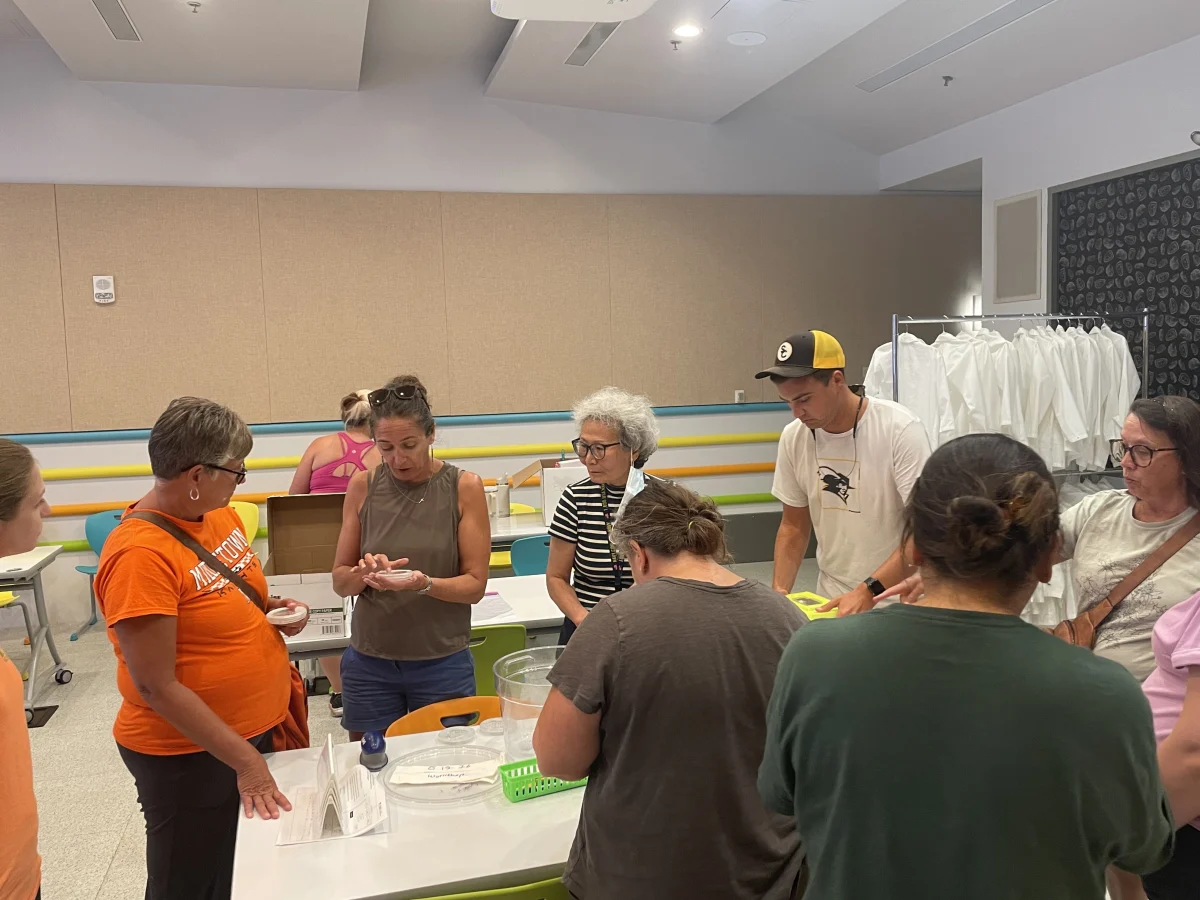
A snapshot of the 2026 workshop, featuring Dr. J. Sook Chung (wearing stripes, center). Photo courtesy of Emily Johnson.
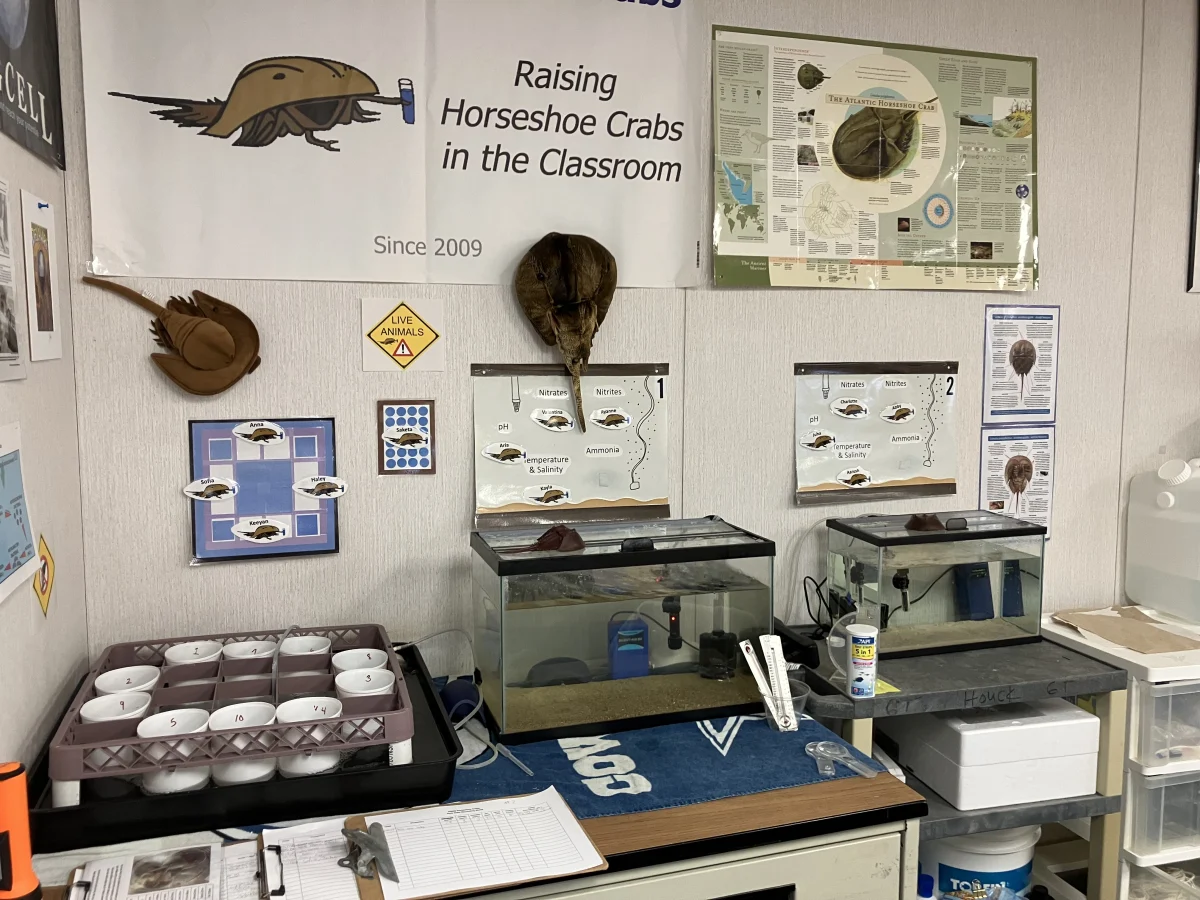
An example of a classroom setup at Pointers Run Elementary School taken in the 2025-2026 school year. Photo courtesy of Jessica Baniak.
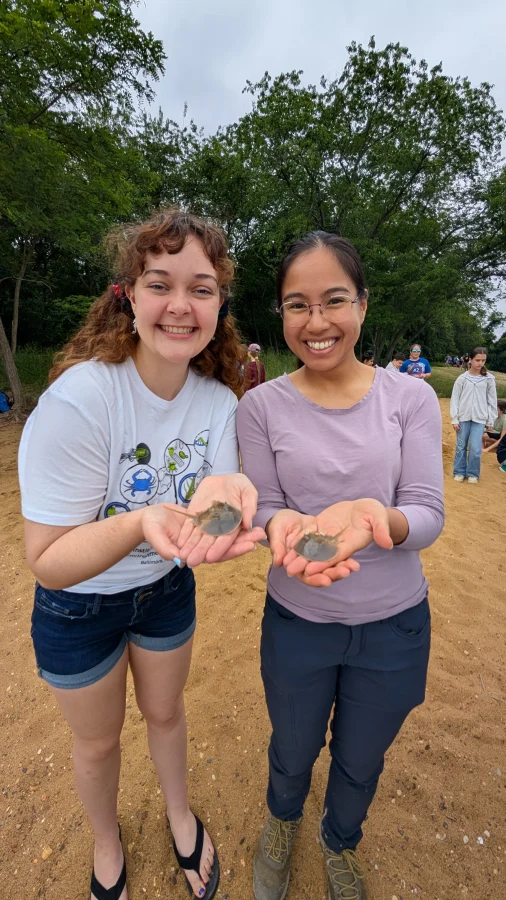
Jessica and a friend with classroom-grown horseshoe crabs at the release event at Sandy Point State Park. Photo courtesy of Stephanie Tuckfield.
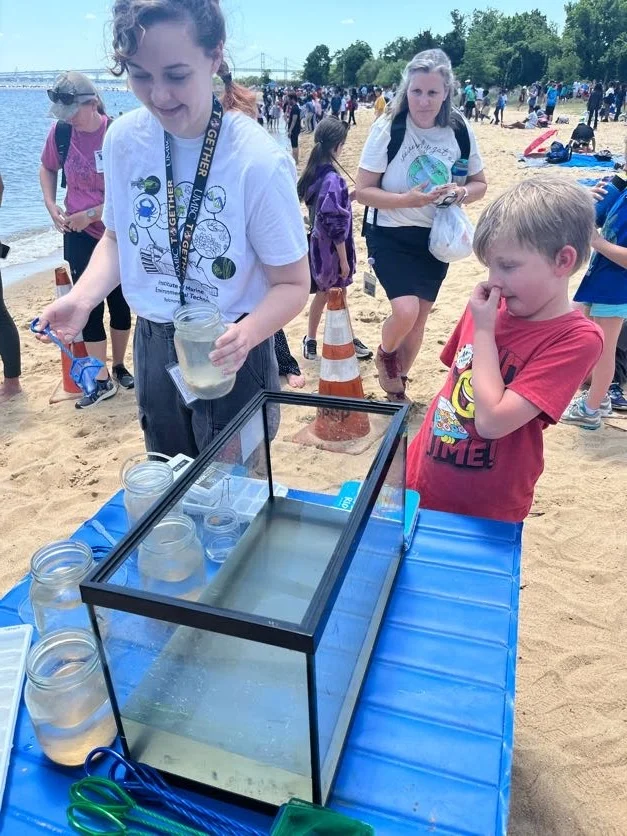
Jessica explains horseshoe crabs to a young visitor at Sandy Point State Park, where the classroom-grown crabs are released into the Bay. Photo courtesy of Stephanie Tuckfield.
Tuckfield had known Chung from previous work at IMET, and in 2022 Chung began helping her get the program going again by refrigerating and storing eggs that Tuckfield collected in late spring, and also raising juveniles that could then be delivered to teachers at the beginning of the school year. (There are now 16 teachers in seven counties participating. Chung also hosts an August workshop at IMET where teachers receive training in the care, feeding, and growth of their classrooms’ crabs.)
Tuckfield was still struggling with crab mortality problems in the classroom—raising tiny horseshoe crabs is not a simple thing—when Baniak, who had started working on her master’s project with Chung, in 2023 began helping her solve some of the husbandry issues.
“For horseshoe crabs, in the beginning stages, you have to have artemia, which are the little brine shrimp. You have to take out a cube of the frozen artemia, dilute it, and then feed it to them, which is pretty complicated for the schools,” Baniak says. “So we’re trying to see, OK, how can we do this where fifth graders can figure this out, and high school students? So just writing the different ways on how to present this, so that it makes sense for all of the different age ranges, different students, and making it as easy for the teachers as possible.”
“She helped me refine my procedures and develop some more concrete feeding structures because the feeding’s always tricky, based off the size or the quantity that you have,” Tuckfield says. “There’s no real formula. So she tried to kind of help me navigate that.” Baniak also came up with a better system for housing the tiny crabs in a way that enabled closer monitoring. And, she immediately connected with the students.
“In terms of Jessica and her outreach, I mean, her enthusiasm’s pretty awesome for this,” Tuckfield says. “The kids really liked her a lot, more than they liked me!” While the teachers would work with Tuckfield, the kids gravitated to Baniak. “I think the students felt really comfortable with her to ask questions, and she would get different information than I would, because this is just a different perspective. So it was really nice to have that additional support when we were going into the classroom.”

At an information session at IMET, Jessica explains to a teacher how to measure the artemia to feed horseshoe crabs. Photo courtesy of Jessica Baniak.
Baniak says that research is fulfilling, but bringing what she studies into the larger community and connecting it with people—especially youngsters—makes her appreciate the work even more.
“I saw how much programs like this meant to the kids and to the teachers…and just seeing them be so excited about it, and watching the kids repeat horseshoe crab facts back at me, I really loved that.” she says. “I really liked that outreach and getting out of the lab, where sometimes you get stuck in your own research when you really want to share it with the world.”
Her experience with the Horseshoe Crabs in the Classroom program spurred her to take a teaching position after graduation; last year she taught eighth grade science, social studies, health, and writing at Baltimore Highlands Elementary School. For part of the science portion, she introduced students to the remarkable horseshoe crab, which most of them had never seen, despite living right next to Chesapeake Bay.
“Those are the lessons that got the kids the most interested, because they’re like, ‘This is real?’ I was like, ‘Yes, yes, it is real.’ And they’re like, ‘Is it a scorpion?’ I’m like, ‘No, not a scorpion.’ Just going through that, but they had no idea about it. And I think what really interested me is that I could teach them something new.”
Baniak says she hopes to return to aquaculture—whether with oysters, clams, horseshoe crabs, or a species to be determined—as long as public education remains part of the equation.
“They all have unique stories, and honestly, every creature’s going have a unique story. It’s just what I want to do, no matter what—being able to do outreach events, and talking to people who really want to hear the story. That’s what I can do, and I can do that a lot of different ways.”
Learn more about horseshoe crabs directly from Jessica in this short video.
Wendy Mitman Clarke is a science writer and sailor based on Maryland’s Eastern Shore. Find more of her work at wendymitmanclarke.com.) (opens in a new tab)