New paper outlines how large language models such as ChatGPT can be used to automate harmful algal bloom prediction
The experiment used ChatGPT to automate the generation of deep learning regression and classification models for harmful algal bloom prediction.
Cambridge, MD – A new paper published in Limnology and Oceanography Letters, lead authored by UMCES’ Dr. Ming Li, demonstrates how machine learning and large language models (LLMs) can be used to increase scientific productivity. Their experiment used ChatGPT to automate the generation of deep learning regression and classification models for harmful algal bloom prediction. A working model was generated in one day, and the entire model development and analysis was completed in 2 months, representing a 10-fold increase in research productivity.
As part of this study, the researchers made publicly available their model source codes and conversations with ChatGPT, hoping they could serve as a demonstration for others in the aquatic and environmental science communities.
“This research is very different from other machine learning approaches because it uses the latest large language models to automate the model development and prediction, making the complex machine learning algorithms widely accessible to environmental scientists and managers who may have limited knowledge in AI,” Li shared.
Key takeaways from the paper:
- Machine learning can transform aquatic and environmental sciences by enabling the analysis of large datasets, pattern recognition, time-series prediction, and decision support.
- It has been challenging to apply it to aquatic and environmental sciences due to the difficulty to master complex machine learning algorithms and codes.
- The authors have demonstrated the power of Large Language Models such as ChatGPT to overcome this challenge and make machine learning models widely accessible to environmental scientists and managers.
“Dr. Li and his collaborators show here how standard AI large language models can accelerate the work of data processing and developing models of complex natural systems that can be used to predict harmful algal blooms,” said Mike Sieracki, director of the UMCES Horn Point Laboratory.
While on a Fulbright visit to Portugal, Dr. Li and colleagues began the collaborative research that led to the creation of this paper. “This paper directly contributes to UMCES’ Chesapeake Global Collaboratory (CGC) initiative that unites scientists, stakeholders, and decision-makers to tackle major environmental challenges using advanced data science,” Li added.
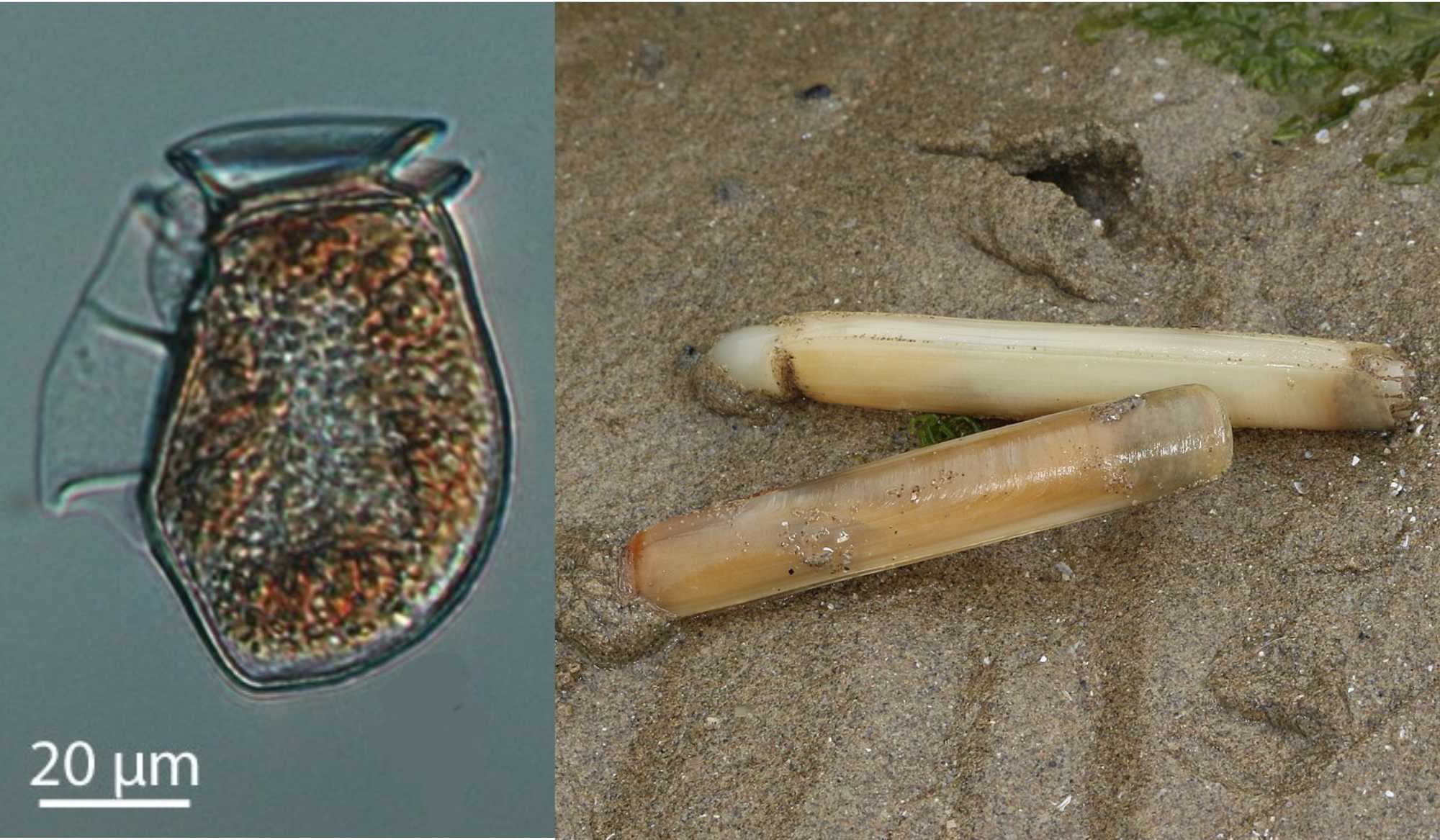
Notes on featured image:
Left: Light micrograph of Dinophysis acuta, a toxin-producing dinoflagellate associated with diarrhetic shellfish poisoning
Right: Grooved razor clam (Solen marginatus), a bivalve species capable of accumulating lipophilic toxins produced by Dinophysis; the specimen shown is representative and not a confirmed toxin-positive individual