Leaping Forward with DolphinWatch
Ten years of the Bay’s greatest participatory science project has revealed how much more there is to learn about dolphins in the Chesapeake.
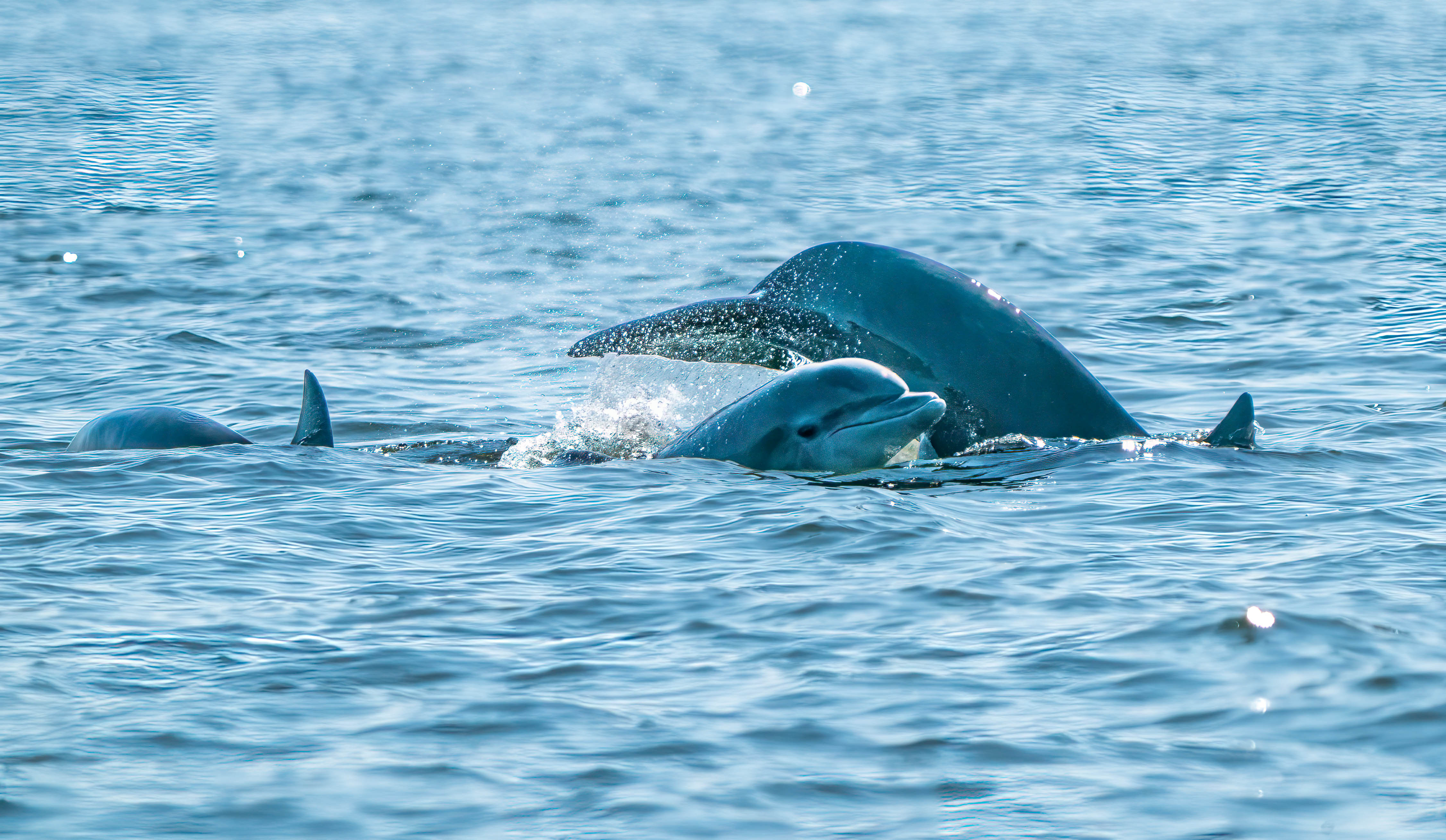
Featured image by Bob Waldrop.
By Wendy Mitman Clarke
By any measure, the participatory science project Chesapeake DolphinWatch has been a great success. Now in its tenth year, the app conceived by Chesapeake Biological Laboratory researchers has more than 20,000 users who have reported more than 12,000 sightings of bottlenose dolphins (Tursiops truncatus) in the Bay. Coupled with acoustic monitoring, the data have supported the first study of bottlenose dolphins that describes where and when they are in the Chesapeake, as well as a model that incorporates water temperature, tidal influence, and salinity to help predict their presence.
“I think Helen [Bailey] and I thought it would be a dozen of our closest friends who reported,” says Tom Miller, fisheries science professor at CBL who was co-investigator with Bailey, and now leads the program, on the Chesapeake Bay Trust grant that got it off the ground. “Now we have really great information on where dolphins are seen in time and space.”
But this wealth of information has also shown what we don’t know about this charismatic species in the Chesapeake—most significantly, how many are actually here. The evolution of DolphinWatch will help tackle new challenges as researchers work to better understand dolphin abundance in the Bay, whether their population is unique or part of other coastal groups (or both), and their role in the Bay’s ecology and food webs. Continuing to leverage the participatory science of Chesapeake DolphinWatch, potentially refining aspects of it to obtain more consistent data, and incorporating cutting-edge science and modeling—all will be key to advancing knowledge of dolphins’ presence and impact in the Bay.
“The next question almost everyone asks is, ‘Well how many dolphins are there in the Bay?’ So the work to estimate how many dolphins are here, what we call our abundance work, is a really high priority,” says Jamie Testa, DolphinWatch project coordinator. “It’s a high priority for us in terms of understanding dolphins’ role in the Bay ecosystem, in the food web. It’s also a priority for other marine mammal management concerns.” Under the Marine Mammal Protection Act, dolphins are managed coastwise by the National Marine Fisheries Service (NMFS), a line office within NOAA. “When managers are looking at population structure and status, they want to know how many animals are coming here. So I think it’s an important question to answer for a lot of reasons.”
It’s also a vexingly difficult question to answer, and its complexities reveal the gaps inherent in DolphinWatch’s methodology and results. Because dolphins are fast swimmers, only coming to the surface to breathe, and because people can’t readily identify individuals, sighting numbers gathered by DolphinWatch participants can’t accurately estimate abundance. Reports of 100 dolphins sighted in the Choptank River on a June day, for instance, doesn’t necessarily mean that 100 individuals are there; there could be duplicate sightings of the same individuals a few miles away, several hours later. Likewise, seasonal data is affected, since more DolphinWatchers are on the water during summer months. Fewer are out in spring and fall, equally important times when dolphins are moving up and down the Bay and its tributaries.

Dolphins in the Elizabeth River, photographed by Denise Gray Maples in December 2023.
One way to refine the information is to supplement it. For example, to help ground DolphinWatch data for their 2021 paper “Spatial and temporal variation in the occurrence of bottlenose dolphins in the Chesapeake Bay, USA, using citizen science sighting data,” Bailey, Testa, and co-authors incorporated and correlated acoustic monitoring at specific sites with refined sighting data. The authors concluded that detections “followed a seasonal pattern similar to the sighting data in the Middle Bay. Each year, [detections on the acoustic monitors] peaked in July and August, with the highest number recorded in July 2017. There was a significant correlation between the frequency of weekly acoustic detections and weekly sightings from 2017 through 2019.”
Another way is to gather more standardized data at the outset. This could include removing some of the randomness of the sighting data by training a subset of DolphinWatch observers to monitor a specific area at specific times. This would help generate more consistent information that could be used to inform studies and models.
“Basically you create a grid where your effort is controlled and you possibly go back to over and over. There are robust statistics designs used in those sighting surveys that do allow you to get an estimate of abundance. So that’s one direction we want to try to go in,” Miller says.
Questions that must be addressed before such a program is implemented, he says, include, “How many people would need to be involved? What’s the relationship between the number involved and the precision of the estimates we get? How do we deal with areas where we struggle to recruit observers?”
“We do want to recruit members of the public, our existing DolphinWatchers, potentially new ones as well, to collect that abundance data,” Testa says. She expects there will be training for observers so they can gather finer data. “It will involve more specifics like, you’re going to have to estimate your distance to the animals and tell us what the sea state is because you can see dolphins more easily and from a greater distance when the water is calm…we’ll be gathering more targeted sighting information.”
Another avenue to estimate abundance, Miller says, is environmental DNA (eDNA). This method uses residual DNA in the water shed by all animals to detect the presence of a species. This is how health officials monitoring outbreaks of illnesses like COVID-19 can estimate how much of the illness is present, by testing eDNA in sewage outflow. Until recently, he says, it wasn’t a reliable way to estimate abundance. But new research is starting to change that.
“NOAA researchers on the West Coast have had pretty good success with some of their major fisheries measuring eDNA to estimate hake abundance, and at the same time measuring with hydroacoustics and net measures, and comparing the three. They’re finding that eDNA pretty well matches abundance from the other sources,” Miller says.

A dolphin in the Nansemond River, photographed by Kim Chase Brown in October 2018.
Additionally, researchers are developing a more precise understanding of how quickly eDNA degrades, which also sharpens the precision of estimates.
“How you can analyze the data and what interpretations you can make and inferences you can draw from those data has fundamentally changed. And what was not possible five years ago I think suddenly becomes feasible now, and it greatly eases the challenge,” Miller says. “If you can go along and sample the water—not have to rely on seeing a dolphin come up for air, just sample the water—you can sample the water whenever you want, wherever you want, at whatever frequency you want. That would be incredibly exciting.”
And, he adds, “You could use DolphinWatchers and give them an eDNA kit, and they could be the ones taking your samples. So we wouldn’t lose that citizen science aspect of it even if we did switch to eDNA, and that’s kind of exciting in itself.”
While eDNA can’t specify exactly how many animals are present, Miller says research is showing that for many animals, such as dolphins, it can reliably indicate relative abundance. These methods can say, for example, there are two times more dolphins in one tributary than another tributary.
“It’s intriguing to think that for most of the organisms we survey in the aquatic environment, we really don’t know absolute abundance,” he says. “We know relative abundance, and from that we know if things are becoming more abundant or less abundant. So eDNA could be a way in which we get relative abundance, and that could be useful, even though non-specific.”
In addition to abundance data, Miller and Testa say another big question about dolphins in the Chesapeake is what are they eating and what role they are playing in the Bay ecosystem. Remarkably, considering their historical presence and their position at or near the top of the Bay’s predators, dolphins have yet to be included in the ecosystem or food web models in the Bay.
“The diet of dolphins is really hard to know, because understandably no one wants to be out there killing dolphins to see what they are eating,” Miller says. “But there are literature sources of observations of dolphins feeding…we would be really interested in putting dolphins in those ecosystem models with our best guesses of what diets are, and then ask, does it make a difference to our understanding of the flow of energy through the food web if we include dolphins in those models or not?”
The 2021 paper noted that, while information is scarce on bottlenose dolphin diet in the Bay, a review of diets from stranded dolphins in North Carolina and coastal Maryland and Virginia “indicated that they most frequently fed on weakfish (Cynoscion regalis), Atlantic croaker (Micropogonias undulatus), and spot (Leiostomus xanthurus).”

A dolphin in the Potomac River, photographed by William Pritchett in July 2023.
Another research avenue spurred by the success of DolphinWatch is getting a better genetic handle on who are the dolphins in the Bay.
“NOAA, in its interest in managing marine mammals, is really interested in collaborating with us to do genetics to try and determine whether or not the dolphins in the Bay are a single population or whether they are from multiple populations,” Miller says. Additionally, he hopes to update research from six years ago to better understand what physical features in the water column—temperature, salinity, dissolved oxygen, etc.—affect dolphins’ distribution in the Bay.
And this is just a start. There is much more to learn about dolphins in the Chesapeake and their relationships to other species and the Bay ecosystem, and Testa feels the legion of dedicated DolphinWatch volunteer scientists could have an additional role to play.
“Funding further research projects inspired by what we’ve learned so far is always a challenge, and science dollars are particularly hard to come by right now. Imagine what the financial support of 20,000 DolphinWatch users could do!”
“Our 10 years is a great start, a good foundation,” Testa says, “And our motivation to keep going is still very strong.”
Wendy Mitman Clarke is a science writer and sailor who lives on Maryland’s Eastern Shore. See more of her work at wendymitmanclarke.com.