Endeavor Fund for Innovative Science awards $60,000 to two promising research projects
Critical early-stage support helps springboard big ideas
Innovative ideas in science start from a basic premise or hunch; they build on prior research or sometimes emerge by happenstance. New ideas must be nurtured – through strong collaboration, robust financing, and institutional encouragement. The Endeavor Fund for Innovative Science, a donor-funded initiative to provide jump-start research support, saw a record number of applicants in 2026. Two of these innovative research projects were selected for funding.
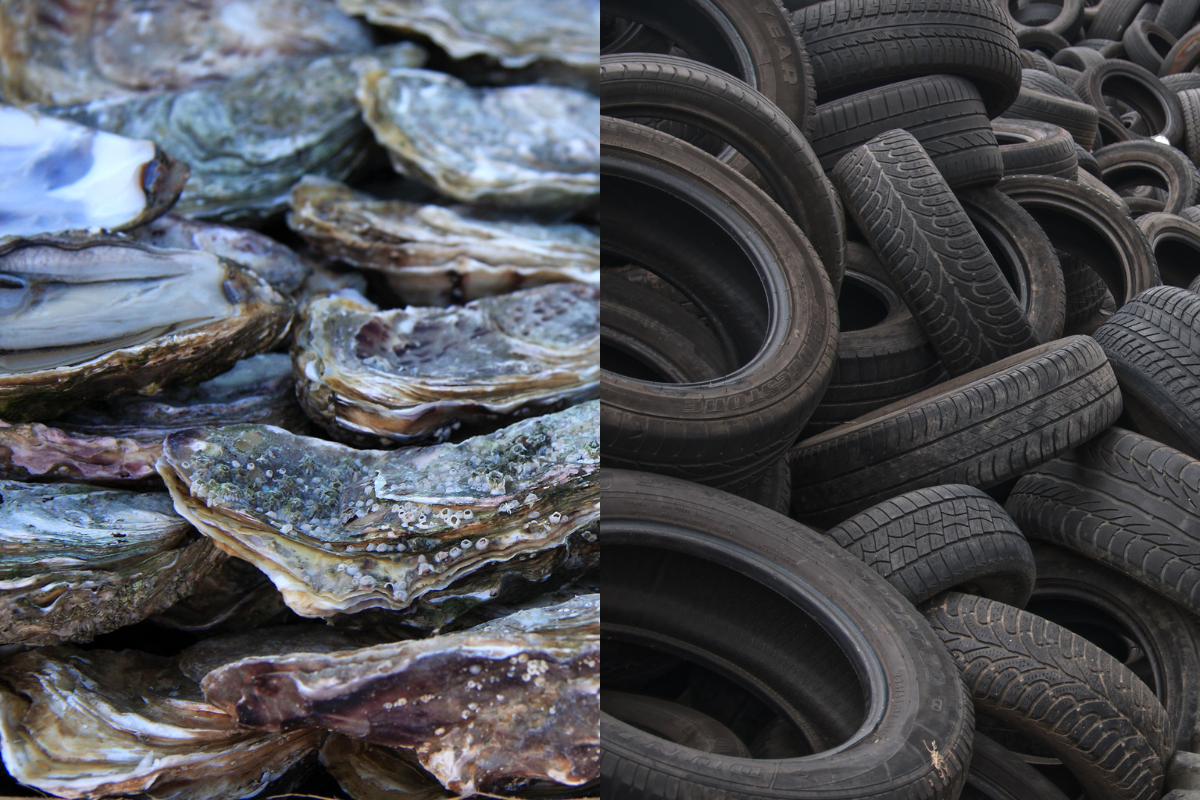
Limin Sun, a postdoctoral researcher at UMCES’ Horn Point Laboratory, observed that oyster breakwaters in the Chesapeake Bay were often failing due to fluctuations in the tide which exposed growing oysters to extreme temperatures. The Oyster Reef Blanket is designed to keep oysters entirely submerged and to provide some thermal insulation, increasing their chances for success and survival.
This award from the Endeavor Fund will support creating the first detailed prototypes of the Oyster Reef Blanket.
“The Endeavor Fund award gave me the resources and encouragement to turn the Oyster Reef Blanket from an idea into a field prototype,” Sun said. “This support helps us develop and test a system that brings oyster restoration and shoreline protection together, with the goal of creating healthier, more resilient coasts.”
Cameron Stacey and Raul Flamenco, students at Chesapeake Biological Laboratory, noticed gaps in analysis of certain compounds associated with tire runoff. As rubber tires break down, they release several compounds, including one called 6PPD. 6PPD degrades in the environment into 6PPD-quinone (6PPD-Q), which has been shown to be toxic to multiple fish species. Stacey and Flamenco’s proposal aims to make a significant step forward in understanding this compound.
The first step will focus on the behavior of 6PPD and 6PPD-Q by studying sites of past fish kills and suspected impact. The second part will aim to quantify these compounds in the area of Deep Creek, MD, where high tire traffic occurs.
“[I] was warned that… securing funding to build those capabilities would be difficult,” Stacey said. “even for seasoned scientists… The fact that the Endeavor Fund makes this kind of work possible for students is proof of how invested UMCES is in educating the next generation of scientists.”
Funds raised during UMCES’ 2026 centennial last year increased the grant from $20,000 to $30,000 this year. These projects are science at its core – researchers asking complex questions and searching for answers. Funding for early-stage research projects like these can be difficult to find, but the findings can have a significant impact on our world, making continued investment critical.
“The Endeavor Fund is an example of where philanthropy can have a multiplying effect on environmental science research. These small grants produce results that can be foundational to leveraging larger investments in further research,” said Lois Colaprete, Vice President for Advancement at UMCES. “We are so grateful to our board of visitors and other donors who value science-based environmental solutions.”
###
About the University of Maryland Center for Environmental Science
The University of Maryland Center for Environmental Science leads the way toward better management of Maryland’s natural resources and the protection and restoration of the Chesapeake Bay. From a network of laboratories located across the state, UMCES scientists provide sound evidence and advice to help state and national leaders manage the environment, and prepare future scientists to meet the global challenges of the 21st century.