The Menhaden Question
While stakeholders argue over menhaden reduction fishery quotas, UMCES researchers focus on science-based guidance to inform complex decisions.
By Wendy Mitman Clarke. All photos in this story courtesy of the NOAA Digital Collections Photo Library.
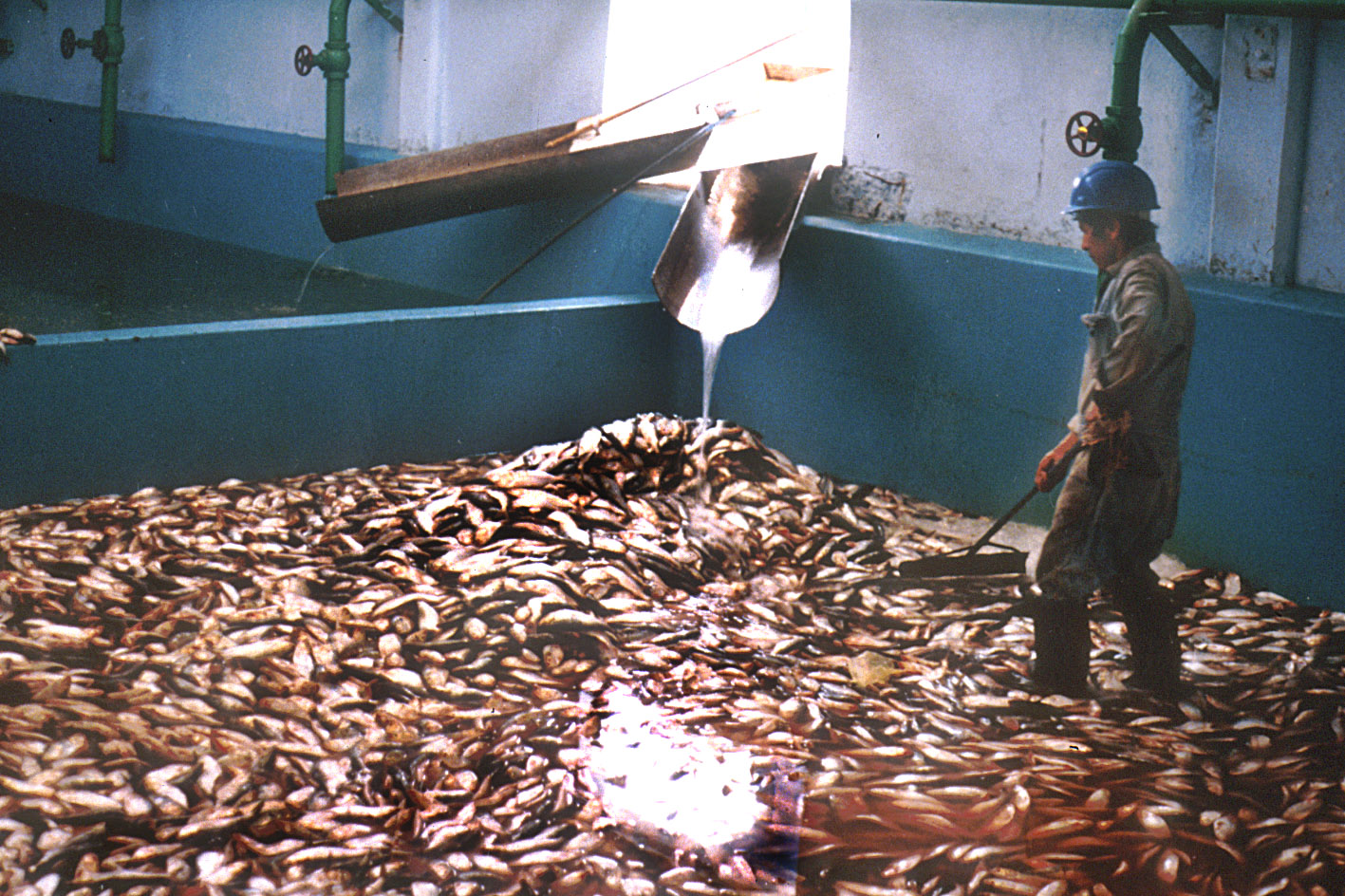
Featured image: Processing Pacific menhaden (Ethmidium maculatum) at Hayduk cannery. Thesef ish are being processed for human consumption. Image credit: Teobaldo Dioses
As Chesapeake Bay creatures go, Atlantic menhaden have never made the limelight like iconic species such as dolphins, striped bass, and ospreys. But this fish’s outsized role in the Bay’s food web, acting as a filter feeder of phytoplankton and zooplankton and in turn serving as a food source for these and other species, makes it one of the most important fish in the Bay.
That role is now the center of an escalating debate about how best to manage the fishery for menhaden (Brevoortia tyrannus). It’s a debate that has been simmering for decades among scientists, regulators, industry, and fishers, and it’s coming to a rapid boil with growing concerns that insufficient menhaden populations are contributing to a sharp rise in osprey nest failures that are putting those birds’ future at risk.
The relationship between menhaden and osprey (Pandion haliaetus) is just one element of the complex story of these fish, but researchers say that one fact is undisputed: Despite all of the years of focus on and discussion about menhaden, we still don’t know enough about their behavior and abundance in the Bay to support foundational scientific data to help guide their management.
“Not knowing that just creates this huge air of uncertainty around what any effects [of management] might be,” says Michael Wilberg, a fisheries science professor at the University of Maryland Center for Environmental Science (UMCES) Chesapeake Biological Laboratory (CBL) who studies fish population dynamics and management strategies. “Understanding the number of fish in a relatively small portion of the area that they use, habitat-wise, is a hard problem…We know generalities about the movement and things like that, but at a fine scale, we don’t understand it. And then trying to figure out what the abundance is at those smaller scales is even harder.”
“We have some data coming out of the Bay, we obviously have fishery dependent data and landings information out of the Bay,” says James Boyle, the Atlantic States Marine Fisheries Commission (ASMFC) fishery management plan coordinator for menhaden. “What we lack is a menhaden-specific total abundance survey…we don’t have that kind of detail for menhaden in the Bay, we don’t have their movement in and out of the Bay seasonally. So we need something that can track them in and out of the Bay or give us a total abundance at one time.”

Poster, broadside, Menhaden. Image credit: Gulf of Maine Cod Project, NOAA National Marine Sanctuaries; Courtesy of National Archives | Archival Photographer Stefan Claesson
To help answer these fundamental questions, Wilberg and Genevieve Nesslage, a CBL associate research professor who specializes in statistical modeling and estimation techniques for fisheries populations and management, are engaged in multiple projects aimed at filling the data gaps. These in turn could provide ASMFC, the organization charged with managing menhaden on the East Coast, with data to support a “scientifically defensible harvest cap” for the Chesapeake Bay menhaden reduction fishery.
“Right now, the cap is basically set on historic landings over a set of years,” says Nesslage, who before coming to CBL was a senior stock assessment scientist at ASMFC. “But we don’t know if that’s biologically meaningful in any way. And we don’t know if that has any ecological meaning either for the predators that eat menhaden.”
One project is a study, funded by the Science Center for Marine Fisheries, a National Science Foundation Industry-University Cooperative Research Center, to define a short-term roadmap of research that would have the best chance of funding, broad stakeholder support, and data-gathering feasibility to “quickly to figure out a reasonable Bay cap that’s based on science,” Nesslage says. “There have been previous efforts to come up with research ideas of what was needed, but they were very broad brush, broad stroke, if you will. This one was, let’s figure out what can be done relatively quickly as in the next two to three years…there’s a lot of work that could be done, but what really needs to be done ASAP was the focus of our task.”
Funded last fall, the Menhaden Roadmap project includes Wilberg and Nesslage from CBL, researchers from the Virginia Institute of Marine Science (VIMS), and NOAA’s lead assessment scientist for Atlantic menhaden. The group’s report is due by the end of this year.
“A lot of it is focused on feasibility and likelihood of success,” Wilberg says. “There are a lot of research ideas out there, but some of them have a high risk of failure and not actually providing evidence in favor or not of the question that people really want to know about. And so, really, one way to think about what we were tasked with doing is sort of prioritizing ways to answer the question, then coming up with budgets associated with what it actually costs to implement that research program.”

Menhaden catch on the NOAA ship GORDON GUNTER being prepared forcounting and measuring. Image credit: Wayne Hoggard
A second project is aimed directly at the question of abundance, and it’s in collaboration with Omega Protein and its partner Ocean Harvesters, the last menhaden reduction fishery operators on the East Coast, whose headquarters, as well as a processing plant and fishing fleet, are based in Reedville, Virginia.
Virginia is the only East Coast state that still has a reduction fishery for menhaden. In the reduction fishery, schools are spotted by planes, and fish are caught in massive seine nets, then “reduced” to products like fish meal and fish oil. Currently, the reduction fishery is permitted to take 51,000 metric tons (mt)—112,435 pounds—of menhaden annually from the Chesapeake, although this cap may change in November (more on that below).
Funded by the same group, VIMS, CBL, NOAA scientists, and Ocean Harvesters are conducting a pilot project to determine the feasibility of using PIT (passive integrated transponder) tags to help track how many menhaden are being caught in the Bay’s reduction fishery and develop abundance estimates based off of those data.
“The basic idea is, we PIT tag menhaden all over the bay, and then we have PIT tag readers on the reduction vessels and in the reduction plant,” Wilberg says. “Those detect if the fish that we’ve tagged get caught, and that information allows us to say what fraction of the fish in the Bay are being caught by the reduction fishery. It also allows us to get population estimates, and say something about movement of menhaden in and out of the Bay.”
The yearlong pilot project is to be completed next spring. One major plant trial has already been completed, Nesslage says, and another is scheduled, “the idea being if it’s not feasible, then it’s off the table and we need to come up with something else.” Early results are positive, though.

Injecting metal tag into a menhaden. Image credit: NOAA Central Library Historical Fisheries Collection; P. 498 of Our Changing Fisheries 1970 Centenary NMFS centenary volume
A Tricky Fish
This research is difficult, Nesslage and Wilberg say, because menhaden are hard to study. Spawning off the East Coast, as larvae they drift into the Bay where they spend about a year growing into juveniles before returning to the coastal adult population. Wilberg says because the fish in the Bay are part of a larger coastal population, they’re always moving, making estimating abundance at any one time and place difficult.
“Menhaden have some behaviors that make it challenging to estimate their abundance,” he says. Two of the main ways scientists gather data about fish are trawl surveys and hydroacoustic monitoring. Menhaden, he says, are crafty at avoiding trawls, and while they typically move in large schools, they don’t like being near or under boats. “That’s where the traditional hydroacoustic focus is—underneath the boat.” So these research techniques, proven for other species, don’t work well for menhaden. Researchers also know that while menhaden often swim near the water’s surface, entire schools also remain submerged, making traditional aerial surveys in the Bay unreliable in terms of estimating abundance.
“It basically means that new survey designs need to be developed…and those are always going to be higher risk, and people haven’t prioritized funding for those kinds of things,” Wilberg says. He and colleagues at CBL, for example, developed new hydroacoustic techniques and aerial survey methods, but the survey was not funded after COVID-19 hit.
“They’re very wily, and they’re very problematic,” Nesslage says. “So we have to come up with something different, and that’s why we kind of have been leaning heavily into the tagging, which is an old school, rock solid way to estimate fish abundance, but it needs to be done on a broad scale across the Bay for this to really, really work.”

Menhaden fishing: off-loading the catch. Image credit: Bob Williams
An Ecosystem-Based Approach
Industrial fishing of menhaden started in the 1850s. At its peak in the 1950s, with no quotas in place, more than 20 processing plants operated from Maine to Florida, taking more than 700,000 metric tons of fish per year. Today, one plant remains on the East Coast—Omega Protein’s Reedville facility.
The ASMFC established the first interstate management for the fishery in 1981. By 2004, though the coastwide assessment found the stock was not overfished, “managers and stakeholders expressed concerns about the potential for localized depletion in the Chesapeake Bay,” noted a 2021 paper, “The Path to an Ecosystem Approach for Forage Fish Management: A Case Study of Atlantic Menhaden,” co-authored by a coastwide group of state and federal scientists including Wilberg, Nesslage, and CBL fisheries science Professor Tom Miller.
Even in 2004, the paper’s authors noted, managers and stakeholders also worried that the fish’s abundance “could be reduced below the level that would be sufficient to maintain their basic ecological functions (e.g., forage base, important link with primary productivity). In response to these concerns, ASMFC implemented an ad hoc harvest cap on the reduction fishery in the Chesapeake Bay starting in 2006. The cap limited the removals of Atlantic menhaden from the Chesapeake Bay for reduction purposes to 109,020 mt, the average of the 2001–2005 reduction landings from the Bay. The Chesapeake Bay harvest cap was intended as a precautionary measure to prevent the expansion of the reduction fishery, representing the first management measure that was explicitly intended to consider Atlantic menhaden’s role as a forage fish.”
Managing a species based on how it supports other species—an ecologically based framework—was a shift from assessing a species in isolation. ASMFC received 157,000 comments in favor of such a move, compared with seven comments supporting single-species reference points, “illustrating the public interest and awareness of the issue and the desire to move to an ecosystem management regime.”
By 2020, the commission adopted a new framework that included using ecological reference points (ERPs) for striped bass. It marked “the first application of quantitative ecological models in management on the United States East Coast and represents a significant step forward for forage fish management in the United States and beyond,” the 2021 paper’s authors noted. But it also highlighted the models’ limits, most importantly, the need for better data across more species.
“The models are only as good as the data and more data is needed,” the authors wrote. “The collection of diet data along the Atlantic coast needs to be expanded to provide seasonally and regionally stratified annual, year-round monitoring of key predator diets to provide information on prey abundance and predator consumption at a finer scale. This could be done through existing data collection programs with an increase in funding and effort. In addition, a long-term research need is improved monitoring of population trends and diet data in non-finfish predators such as birds and marine mammals and prey species such as bay anchovy, sand lances…and benthic invertebrates to better characterize the full ecosystem dynamics.”

Osprey building a nest. Pair of young osprey (Pandion haliaetus) buildinga nest on the crow’s nest of a NOAA ship – before the nest was moved to aman-made platform at the Sandpoint NOAA campus. Image credit: NOAA/NMFS/West Coast region | Enrique Patino
Among the various models that ASMFC studied, a data-hungry, finer-scale, full-ecosystem model allowed for adding more predator species, including ospreys. For the 2025 ERP assessment ospreys were included as predators in that model. The full model “showed that striped bass and osprey were two of the most sensitive species to menhaden fishing,” the ASMFC noted (opens in a new tab). Because the working ERP model is designed around striped bass, “an ERP target and threshold that would provide adequate forage for striped bass would likely not cause declines for other predators in the ecosystem, including osprey.”
Recently, however, the focus of menhaden conservation in the Chesapeake has changed from conserving striped bass to conserving ospreys. Ospreys’ recovery on the Chesapeake since the 1970s is one of the Bay’s great success stories, with the population increasing from 1,450 breeding pairs in 1973 to more than 10,000 today. But decreased reproduction in recent years, particularly in the Bay’s saltier regions where menhaden are a primary food source, are raising red flags for some.
In a Frontiers in Marine Science paper (opens in a new tab) published in June, “Widespread reproductive deficits in Chesapeake Bay ospreys,” lead author Bryan Watts, research professor at William & Mary, noted that in 571 nests monitored during 2024, “Reproductive rates…are below those reported during the height of the DDT era.” The authors pointed to the menhaden fishery for the lower levels of osprey reproduction.
Wilberg, however, says that the linkage between the menhaden fishery and osprey is not clear.
“These studies have shown that osprey reproductive rates have declined in some parts of the Bay, but the causes have not been identified.” In particular, Wilberg notes that changes in the amount of time menhaden spend near the surface, abundance of other fish, or interactions with other bird species like bald eagles have not been rigorously evaluated. “Jumping directly to a cure without diagnosing the cause of the problem means that we may make major management changes that don’t help ospreys but harm the fishery,” Wilberg says. The Menhaden Roadmap project will describe the types of studies that can address the linkage between the menhaden fishery and ospreys.

Atlantic menhaden larvae. Image credit: NOAA Central Library Historical Fisheries Collection
Harvest Cap Questions
Since 2018, the Chesapeake Bay harvest cap for the menhaden reduction fishery has stood at 51,000 mt. However, all eyes are on the ASMFC’s November meeting, where it is considering lowering that cap by 50%. Another possibility is shifting the timing of the fishery in the Bay so that it doesn’t overlap with periods when osprey parents are most pressured to find fish to feed their young—late spring and early summer, for example. The ASMFC is also considering attaching the cap more directly to the coast-wide total allowable catch (TAC), so that when the TAC expands or contracts, so does the Bay harvest cap. The commission could also choose to keep the status quo.
Meantime, after repeated attempts in the Virginia legislature to fund menhaden research failed, in June, Gov. Abigail Spanberger allocated $2 million to VIMS and the Virginia Marine Resources Commission for that purpose. Nesslage says the major funding is a welcome change in momentum.
“No one’s dedicated any money to this until recently, to be honest,” she says. Without sufficient funding, the science to help answer the questions struggles to advance.
“The ideal outcome of all of this is basically having science-based management where at least people can agree on the facts,” says Wilberg. “If we can get to that point where we get relatively broad agreement on that, we’ll have made huge, huge progress.”
Wendy Mitman Clarke is a science writer and sailor who lives on Maryland’s Eastern Shore. See more of her work at wendymitmanclarke.com.