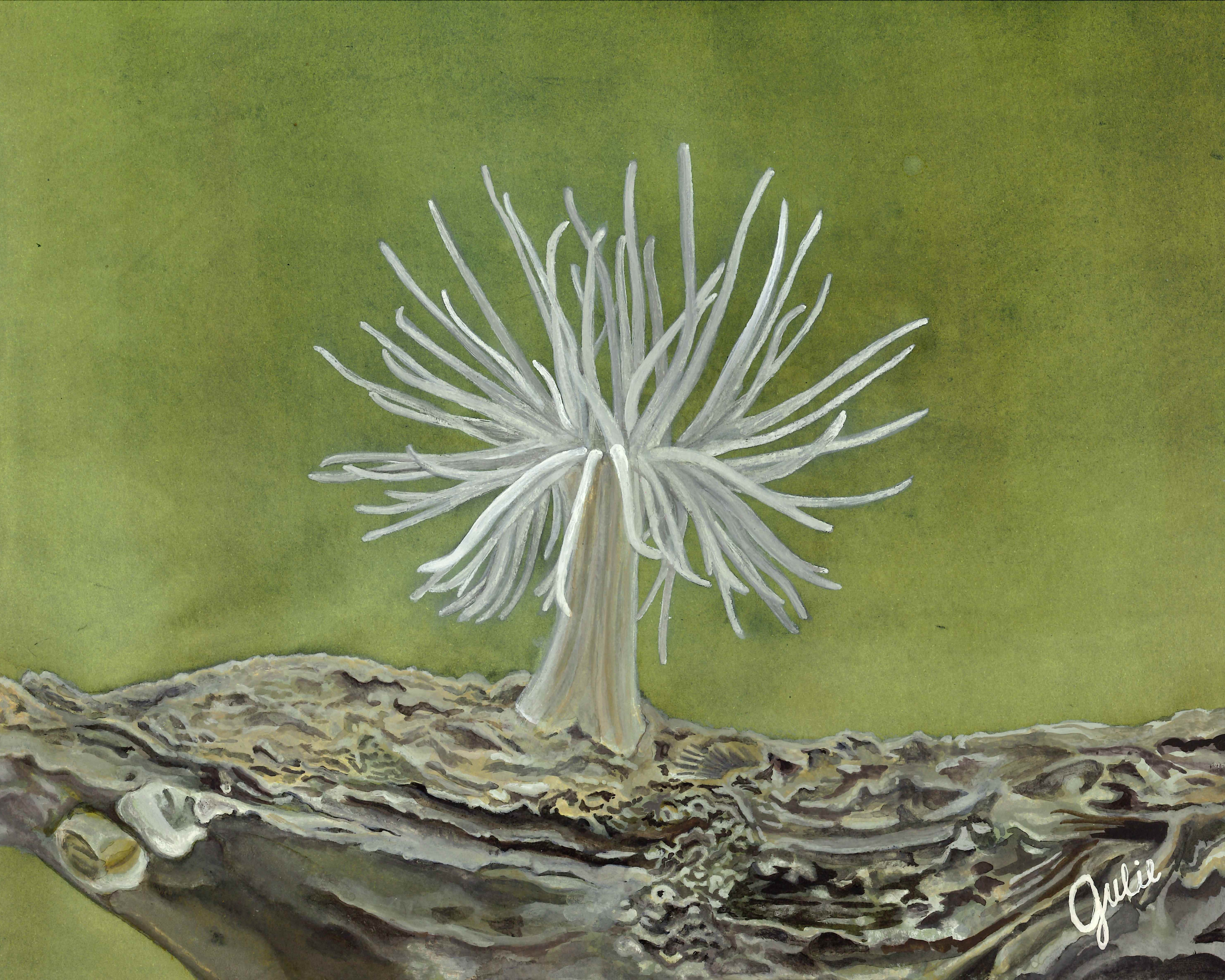

October 2025 Critter of the Month: Ghost Anemone
PhytoChop Coastal Observatory Home Critter of the Month Home
For this spookiest of seasons, Critter of the Month is showcasing the Ghost Anemone, Diadumene leucolena, a translucent, haunting predator. This menacing hunter anchors itself to solid substrates like rocks and pilings, its 40 or more tentacles swaying around its slit-like mouth, ready to strike prey that drifts within reach. Like their cousins the jellyfish, anemone tentacles are armed with specialized stinging cells (nematocysts) which fire harpoon-like filaments at the slightest touch, injecting paralyzing toxins into unsuspecting prey. Once stunned, the prey is guided by those same tentacles into its waiting mouth. Although anchored, the Ghost Anemone can creep along surfaces, positioning itself into a favorable spot for hunting.
Their common name refers to their translucent bodies and tentacles, white to pinkish in color. Of course, these predators are only about 1.5 inches tall when fully extended and about a half inch wide, and so tend evoke cuteness rather than fear . As expected for its diminutive size, it feeds on the smallest plants and animals in their waters, typically plankton and tiny juvenile fish. The Ghost Anemone is quite small among anemones. Some giant species like the Giant Plumose Anemone (Metridium farcimen) of the Pacific Coast, can reach over 3 feet tall fully extended. The Ghost Anemone is one of only a few species of sea anemones native to the Chesapeake Bay, where it is abundant and widespread, living on rocks, reefs, oyster shells, pilings, and other hard surfaces in shallow waters, particularly in areas of low-medium salinity. They are themselves are prey for other predators in the Bay including fishes, sea stars, and snails, making them a part of the Chesapeake food web.
Behind the Watercolor
To create her watercolors, Julie starts by photographing her subjects. Some of these have been critters she has seen incidentally around campus (such as the Eastern Box Turtle and the Osprey), while others she has encountered while examining water samples from the Choptank River through her microscope (e.g., Gammarus, Dinophysis). In the case of the Ghost Anemone, to avoid making her subject look like a blob of jelly, Julie staged a photoshoot in an aquarium so she could capture its ring of tentacles fully extended. She fed it with brine shrimp, and you can see the ingested prey moving through their transparent bodies into their gastrovascular cavity.
Two Siblings, Two Strategies
The Ghost Anemone is native to the Atlantic coast of North America. Its close relative, the Orange-Striped Green Anemone (Diadumene lineata), is similar in size and habitat requirements but comes from the Sea of Japan and sports a distinctive orange stripes on its body. Both species have spread from their native waters and now live in coastal areas around the world, often side by side in the same locations. Yet, their success as colonizers differs dramatically: the Orange-Striped Green Anemone has become the most widespread sea anemone in the world and is considered invasive in most places it occurs, while the Ghost Anemone only rarely establishes populations outside its home range.
What accounts for this difference? First, the Orange-Striped Green Anemone is hardier in many respects, better able to survive extreme temperatures and drying out. This makes it an effective stowaway or hitchhiker in ship ballast transported around the globe, as well as on aquaculture shellfish.
Secondly, the two species have evolved divergent reproductive strategies. The Ghost Anemone reproduces sexually, with separate males and females releasing gametes into the water, which develop into larvae that must find suitable habitat to settle and grow. The Orange-Striped Green Anemone can also reproduce this way, but relies heavily on simply splitting itself or budding off copies of itself (asexual reproduction), which is especially frequent in warm water. This creates a critical trade-off. When the Orange-Striped Green Anemone reproduces by budding, entire populations often consist of just a few genetically identical clones. If conditions suddenly become unfavorable, all the clones may die at once, leading to dramatic population crashes. The Ghost Anemone’s sexual reproduction maintains genetic diversity, so when conditions deteriorate, some individuals are likely to have the right genetic makeup to survive, resulting in more stable populations over time.
But asexual reproduction offers a powerful colonization advantage: a single Orange-Striped Green Anemone arriving at a new location can rapidly build an entire population by cloning itself. The Ghost Anemone needs many individuals, both males and females, to arrive at the same place to establish a breeding population. This makes the Ghost Anemone far less likely to become invasive, but ensures that its established populations are more resilient and persistent in the long run.
Looking for More Information?
Chesapeake Bay Program: https://www.chesapeakebay.net/discover/field-guide/entry/ghost-anemone
Glon, H., Daly, M., Carlton, J.T. et al. 2020. Mediators of invasions in the sea: life history strategies and dispersal vectors facilitating global sea anemone introductions. Biol. Invasions 22, 3195–3222. https://doi.org/10.1007/s10530-020-02321-6
Will H Ryan, Jaclyn Aida, Stacy A Krueger-Hadfield. 2021. The Contribution of Clonality to Population Genetic Structure in the Sea Anemone, Diadumene lineata, J. Heredity, 112: 122–139. https://doi.org/10.1093/jhered/esaa050