
Services & Tools
The University of Maryland Center for Environmental Science operates world-class research facilities at its locations across the state.
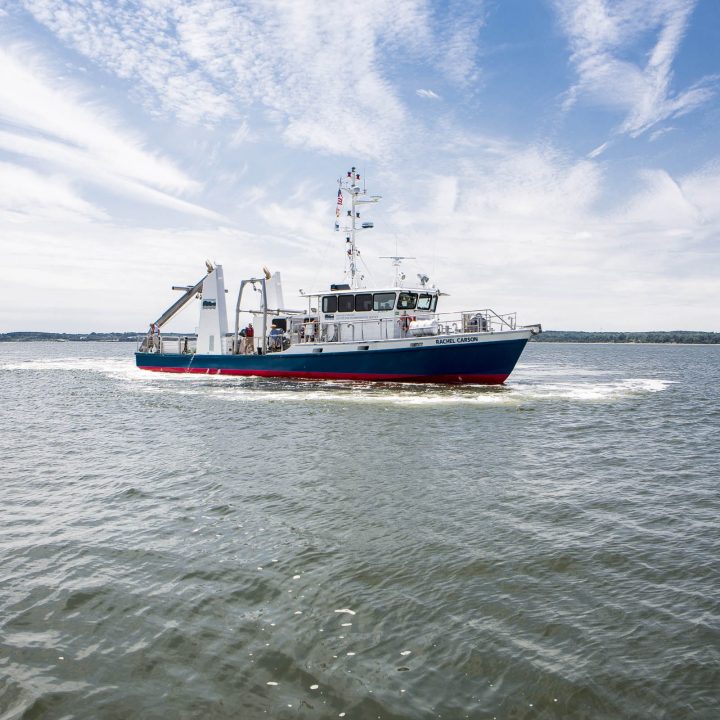
These include specially designed laboratories with advanced instrumentation for chemical and biological experiments and analyses, including DNA sequencing and advanced molecular and isotopic measurements; seawater systems for maintenance of and experimentation with marine and aquatic organisms; extensive shellfish and finfish aquaculture facilities; greenhouses; computational and geographic information systems; the state-of-the-art research vessel Rachel Carson; and automated environmental observing systems.
Our Services & Tools
Analytical Services Laboratory at Horn Point
The Analytical Services Laboratory at Horn Point provides a wide range of water quality analyses for investigators from the University System of Maryland and around the world. All analyses follow strict QA/QC procedures.
Anthropogenic Changes in Estuarine Systems (ACES) Center
The ACES center provides analytical support for UMCES scientists and external entities in measuring a variety of target chemical contaminants together with non-target chemical screens. This includes legacy persistent contaminants and contaminants of emerging concern in all environmental matrices (e.g. fresh and marine waters, sediment and biota). Education is a key component, and scientists are trained using state-of-the-art analytical equipment and procedures. Example analytes include wastewater treatment plant and septic tracers, tire compounds, pharmaceuticals and personal care products, PFAS, and algal toxins, amongst others.
BioAnalytical Services Laboratory at IMET
The BioAnalytical Services Laboratory (BAS Lab) provides sequencing services and instrument availability to promote advances in genomics and molecular biology research. Located at the Institute of Marine and Environmental Technology, BAS Lab services are available to investigators from institutions nationwide.
Cell Analysis Center at Horn Point
The CAC at Horn Point uses optics to study aquatic microorganisms using microscopy (fluorescence and phase contrast) and flow cytometry. Research conducted at the CAC focuses on the study of aquatic algaes, planktonic species, bacteria and archaea, to constrain their respective roles in nutrient cycling and global ecology.
Central Appalachians Stable Isotope Facility at Appalachian Laboratory
The Central Appalachians Stable Isotope Facility performs stable isotope measurements on a variety of sample matrices. It measures stable isotope ratios of carbon, nitrogen, hydrogen, and oxygen in environmental samples of solids, liquids, and gases using Thermo Fisher Delta V+ isotope ratio mass spectrometer interfaced with various peripheral devices.
Environmental Statistics Collaborative at Chesapeake Biological Laboratory
A clearinghouse for environmental measurements, the Environmental Statistics Collaborative is based at the Chesapeake Biological Laboratory and provides state-of-the-art education in environmental statistics to UMCES graduate students, provides research expertise to faculty researchers, and offers consulting services to partners in the scientific and natural resource management community.
Nutrient Analytical Services Laboratory at Chesapeake Biological Laboratory
The Nutrient Analytical Services Laboratory at the Chesapeake Biological Laboratory provides analytical support to researchers of UMCES, state and federal agencies, and private sector in water column chemistry, particulate and sediments, and other chemistries.
Oyster Culture Facility at Horn Point
The Broddus and Margaret Ann Jones Oyster Culture Facility at Horn Point, one of the largest oyster hatcheries on the East Coast, produces a variety of oyster larvae for use in oyster research, oyster restoration, and educational projects.
PhytoChop Coastal Observatory at Horn Point
PhytoChop is a state-of-the-art phytoplankton observatory located on the Horn Point research pier adjacent to the Choptank River. PhytoChop houses several state-of-the-art instruments in a climate-controlled enclosure that collectively provide a detailed view of the daily to seasonal changes in the phytoplankton community composition, activity, and environmental correlates.
Research Fleet at Chesapeake Biological Laboratory & Horn Point
The UMCES Research Fleet Operations Center is based at the Chesapeake Biological Laboratory and is the homeport for the R/V Rachel Carson. It also oversees small boat at both the Chesapeake Biological Laboratory and the Horn Point Laboratory.
Stable Isotope Lab at Chesapeake Biological Laboratory
The Stable Isotope Laboratory at CBL gives UMCES student and faculty, as well as outside collaborators the opportunity to analyze a variety of light stable isotopes in gas form (carbon, nitrogen, oxygen, and hydrogen). Education is a strong priority for the lab, and students can learn analytical methods pertinent to their research, from sample preparation to data analysis and interpretation.
Water Chemistry Analytical Laboratory at Appalachian Laboratory
The Appalachian Laboratory's Water Chemistry Laboratory provides high quality analytical services for UMCES researchers, as well as for a variety of state, local, and private agencies, on water, soil, and plant samples. Constituents include, but are not limited to, nutrients, trace metals, and common acid/base parameters.