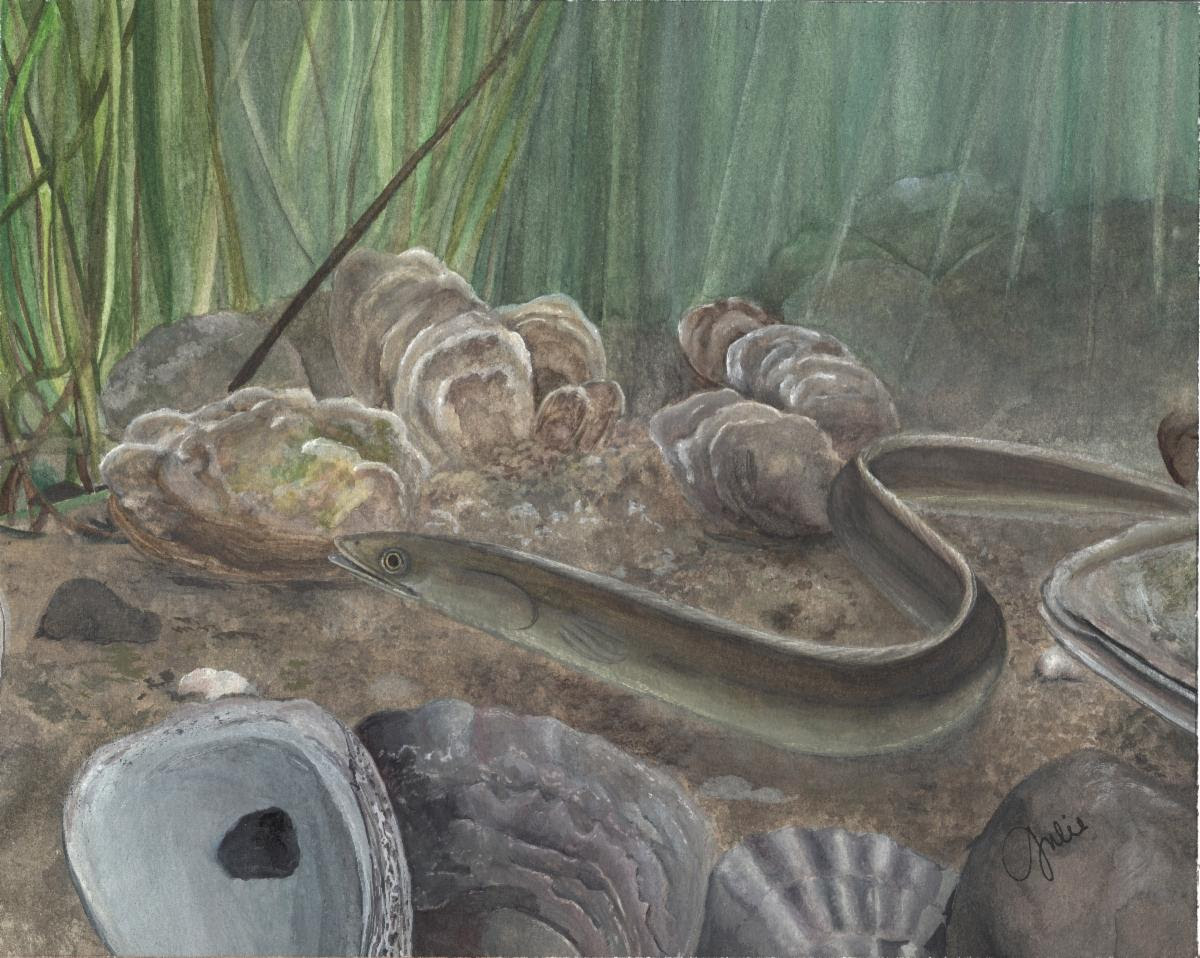

August 2026 Critter of the Month: American Eels
PhytoChop Coastal Observatory Home Critter of the Month Home
Meet the American Eel
One of the world’s most enigmatic creatures, the American Eel is a nocturnal, bottom-dwelling predator that can look more like an aquatic snake than what it truly is: an early-diverging fish. It belongs to the freshwater eel family (Anguillidae) and is most closely related to the European Eel (Anguilla anguilla) and the Japanese Eel (Anguilla japonica). Like its relatives, it has a slender, serpentine body sheathed in mucus that helps protect it from parasites. It does have gills, though the openings are small, and it does have scales, though they are minute, rudimentary, and embedded beneath the skin, making it appear scaleless. Eels live in close association with the sea- or lake- floor, where they tend to hide through the day and through cold months. Adults are variably colored, from olive-green to brown or yellowish, and though sizes vary greatly, they can exceed three feet in length, with females typically larger than males.
Adult American Eels are found throughout the freshwaters accessible to the Atlantic Ocean (lakes and streams) as well as estuaries and coastal bays, from as far north as Greenland to as far south as Venezuela. Because they can access the Great Lakes and the Mississippi River, and their many tributaries, American eels can be found as far inland as Minnesota and Wisconsin.
The Chesapeake Bay has historically supported one of the largest American Eel populations in North America and has accounted for a large share of the U.S. harvest of these fish. Among its subestuaries, the Choptank River has been notable for productive growth habitat and abundant, fast-growing eels . In the Choptank, the fresher upper reaches tend to host the larger females (two to five feet), while the mesohaline waters host the smaller males (around two feet). But like American Eels throughout their range, the Bay’s population has trended downward over time .
In freshwaters and the Chesapeake Bay, American Eels are eaten by a variety of predators, such as fish and diving birds, though they are rarely a primary prey item. Nevertheless, they can play a uniquely important role in their ecosystems. In the Chesapeake Bay watershed, the American Eel is recognized as an essential host in the life cycle of the Eastern elliptio mussel (Elliptio complanata), a freshwater mussel whose larvae metamorphose most successfully on eels, and whose adults are beneficial members of the ecosystem, helping keep the water clear through filter feeding.
The American Eel’s life cycle is described as “catadromous”, meaning it grows to maturity in fresh and brackish water but spawns in the sea. Although the freshwater stage is distributed across a vast swath of the continent, all American Eels are thought to begin and end their lives in the Sargasso Sea. This is an expansive region in the western Atlantic ringed not by land but by ocean currents. After hatching there, transparent, leaf-shaped larvae called leptocephali (“slim-headed”) drift on currents toward North America for roughly nine to twelve months, metamorphosing into transparent “glass eels” as they reach the continental shelf. As they grow, they gain pigment, and become known as “elvers”, and push upstream. When they settle in to their newfound homes, they become adult “yellow eels”. The making of male and female eels is fascinating and still not fully understood. Their gender is not fixed genetically at birth, but becomes set by the environmental conditions such as eel density and salinity during this yellow stage. Eels may live as yellow eels for many years, even a couple decades, and they tend to stay put during this stage. Then, for reasons that are still poorly understood, they undergo a final metamorphosis into the “silver eel” stage, which readies them for the long return back to the Sargasso Sea. In this transformation, their eyes shift toward blue-sensitive vision suited to the deep ocean, their reproductive organs mature, and amazingly, their guts degenerate so they stop feeding entirely, and live on their stored energy reserves for the rest of their lives. Silver eels then migrate, without feeding, for well over a thousand miles over many months, back to the Sargasso Sea to spawn and expire, completing their full life cycle.
The Eel Question
The freshwater eels’ life cycle has been a source of mystery and intrigue for centuries, captivating thinkers from Aristotle to Rachel Carson. Contrasting eels with anadromous fish (those that live as adults in the ocean but return to rivers to breed) helps illustrate why. Salmon, famously, run up rivers in full breeding color, build nests, and deposit and fertilize eggs that hatch into visible juveniles. These are dramatic displays that are plain to observe. Eels are almost the complete opposite. In rivers and estuaries, they are not sexually mature and never reproduce, and for centuries no one could find their eggs or witness their spawning. The puzzle was old enough that the ancient Greek philosopher Aristotle reportedly concluded freshwater eels must arise not from reproduction at all, but could spring spontaneously from mud.
The search for where American and European freshwater eels actually reproduce is largely credited to a Danish scientist, Johannes Schmidt, who spent close to two decades near the start of the 20th century in search of the breeding grounds of the European Eel. Towing nets across the Atlantic and tracing progressively smaller larvae, he was led shortly after the Great War, to the Sargasso Sea. The smallest leptocephalus larvae of both the European and the American Eel have been collected there. Soon after, in 1926, Marie Poland Fish reported four eggs, putatively of the American Eel, recovered from a deep Sargasso trawl, which hatched into leptocephalus larvae. From these pieces of evidence, the Sargasso has been judged the most likely place where both species breed and ultimately expire.
The curious thing, which persists to this day, is that no adult American or European Eels, alive or dead, has ever been observed in the Sargasso Sea. The evidence that this is their breeding ground remains primarily indirect. In one relatively recent study, researchers fitted pop-up satellite tags to more than 700 migrating European Eels. Much was learned about their movements offshore, but every tag detached or the fish was lost before reaching the Sargasso . Since then, a smaller but more targeted study was able to trace 5 tags fixed to female silver European eels to the Sargasso of which a single one was located within the presumed breeding ground. A comparable effort with American Eels tracked a single tagged silver eel roughly 2,400 km toward the northern edge of the presumed spawning area before the tag came off, short of the inferred spawning grounds. (The Japanese Eel, by contrast, has been traced to spawning grounds near the West Mariana Ridge in the western North Pacific, where both its eggs and spawning adults have been confirmed and collected.)
Finding their probable deep breeding grounds is challenging and expensive, and with their numbers at historical lows, due to damming, fishing, and perhaps other pressures, such as poaching (an illegal glass eel trade), pollution, parasites, and shifting ocean current/climate conditions, there is a real possibility the question may never be conclusively resolved. Yet, the more completely we understand the American eel’s remarkable life history, physiology and ecology, the better equipped we may be to protect it.
Want to Know More?
Aoyama J, Watanabe S, Miller MJ, Mochioka N, Otake T, Yoshinaga T, et al. 2014. Spawning Sites of the Japanese Eel in Relation to Oceanographic Structure and the West Mariana Ridge. PLoS ONE 9(2): e88759. https://doi.org/10.1371/journal.pone.0088759
Béguer-Pon, M., Castonguay, M., Shan, S. et al. 2015. Direct observations of American eels migrating across the continental shelf to the Sargasso Sea. Nature Communications 6: 8705. https://doi.org/10.1038/ncomms9705
Fenske, K. H., D. H. Secor & M. J. Wilberg. 2010. Demographics and parasitism of American eels in the Chesapeake Bay. Transactions of the American Fisheries Society 139: 1699–1710. [confirm volume/pages against your copy]
Fish, M. P. 1926. Preliminary note on the egg and larva of the American eel (Anguilla rostrata). Science 64(1662): 455. https://www.science.org/doi/10.1126/science.64.1662.455
Righton, D. et al. 2016. Empirical observations of the spawning migration of European eels: the long and dangerous road to the Sargasso Sea. Science Advances 2: e1501694. https://doi.org/10.1126/sciadv.1501694
Schmidt, J. 1923. Breeding places and migrations of the eel. Nature 111: 51–54.
Svensson, P. 2020. The Book of Eels. Ecco/HarperCollins.
Virginia Institute of Marine Science. American eel juvenile abundance index (Chesapeake tributaries). https://www.vims.edu/research/units/programs/juvenile_surveys/data_products/indices/americaneel/
Wright, R. M., Piper, A. T., Aarestrup, K. et al. 2022. First direct evidence of adult European eels migrating to their breeding place in the Sargasso Sea. Scientific Reports 12: 15362. https://doi.org/10.1038/s41598-022-19248-8