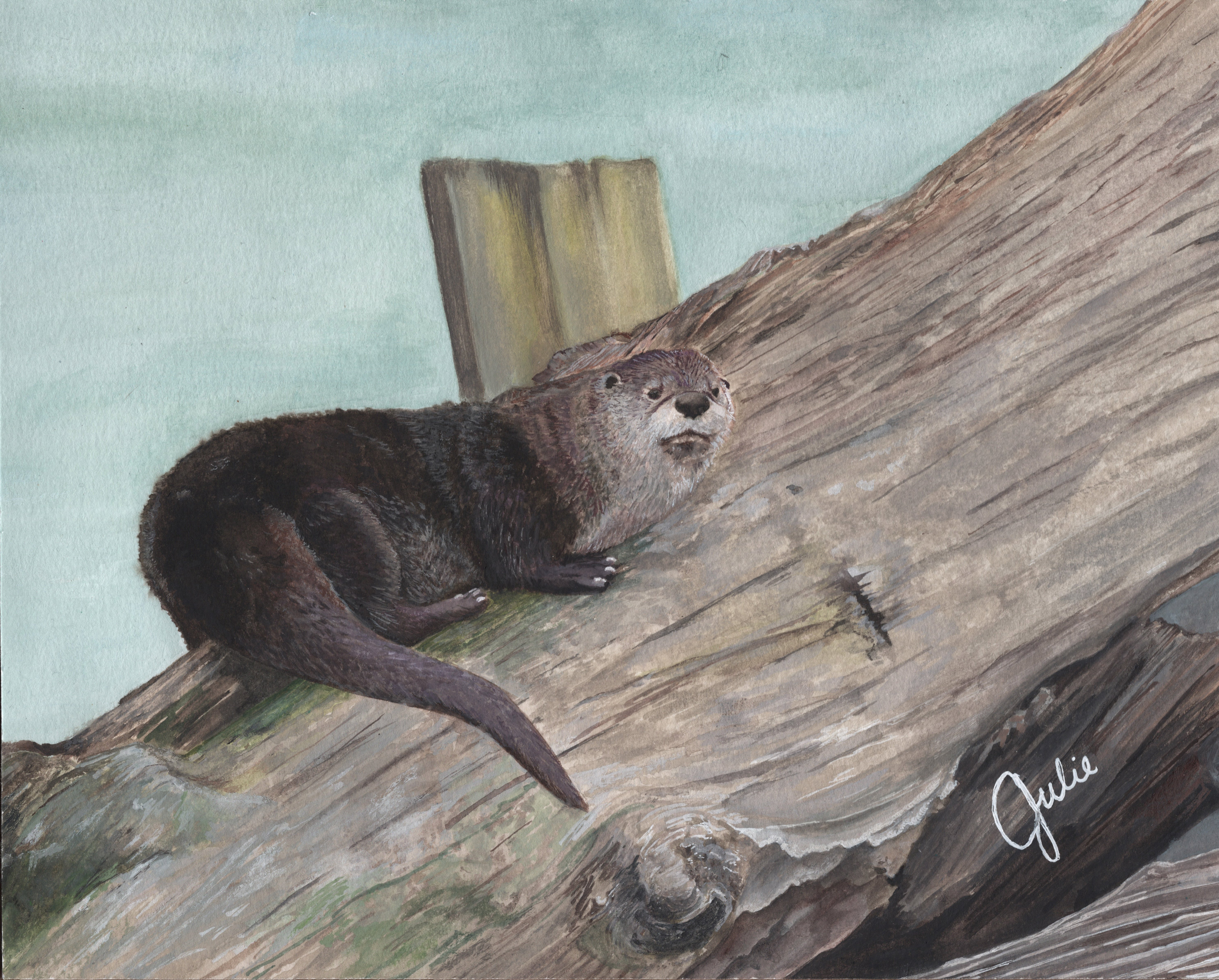

July 2026 Critter of the Month
Meet the River Otter
Lontra canadensis is the North American River Otter, a member of the weasel family (Mustelidae), which are carnivorous mammals. There are an estimated seven subspecies, and ours is the southeastern L. c. lataxina subspecies (opens in a new tab). They’re semi-aquatic and find habitat along river shorelines. These animals are top predators in food webs, feeding primarily on fish, along with other small prey. They use their long whiskers to sense prey in murky water.
River Otters really are playful
I remember the first time I saw river otters. I was on a back-country canoe trip with friends. We were perched on a rock overlooking a small river for a rest and food, when we heard animals squeaking and romping, coming around a bend in the river. It was a small family of otters playing in the water! It was one of those moments when you feel like you’re in your own personal nature show.
In literature and popular videos, river otters are depicted as being amongst the most playful mammals. This is not just an activity of captive river otters. In the wild, they really do wrestle (opens in a new tab) and they really do slide on mud and snow (opens in a new tab), and they seemingly do this, at least in part, just for the fun of it.
River Otters are making a comeback in the Chesapeake Bay area
The Eastern Shore of Delmarva has always been a good home for River Otters, and we can find evidence of these animals on the Horn Point Campus. If you take a look at the re-built bridge on campus, you might be treated to blackberries this month, and river otters in the early or late times of the day.
In more urban areas that have suffered habitat disruption or water-quality decline, river otters had dwindled across much of the Chesapeake region over the last century, thinned by trapping, pollution, and land use change. But that decline has been reversing, and this summer the Bay Journal wrote a feature about river otters showing up in even some of the Bay’s most developed and historically polluted waters, including a floating wetland in Baltimore’s Inner Harbor, downtown Norfolk, and Rock Creek. Read more details here. (opens in a new tab)
River Otters really do build social bonds while pooping together.
Researchers at the SERC lab are tracking pathogens of river otters by monitoring the DNA in their poop, which they are gathering from “otter latrines”. It’s a similar idea that drives our work at PhytoChop. Living things are constantly shedding traces of DNA into their surroundings, and by reading that environmental DNA (eDNA) or fecal DNA (fDNA), we can piece together valuable ecological information. From the fDNA collected in otter latrines, SERC scientists can reconstruct what the animals have eaten and which parasites they carry. At PhytoChop, we sample eDNA straight from the Choptank’s water to track which organisms are present and when, week after week.
But, I can’t do this otter latrine story justice. It’s scientifically fascinating, it’s funny, and it’s pretty gross. So I’ll just put a link here, and suggest you should read it yourself. (opens in a new tab)
Would you like to be an Otter Spotter?
Report your Sightings here:
https://serc.si.edu/chesapeake-bay-otter-alliance/get-involved/have-you-seen-otters-in-your-area
https://elizabethriver.org/community-science/