June 2026 Critter of the Month
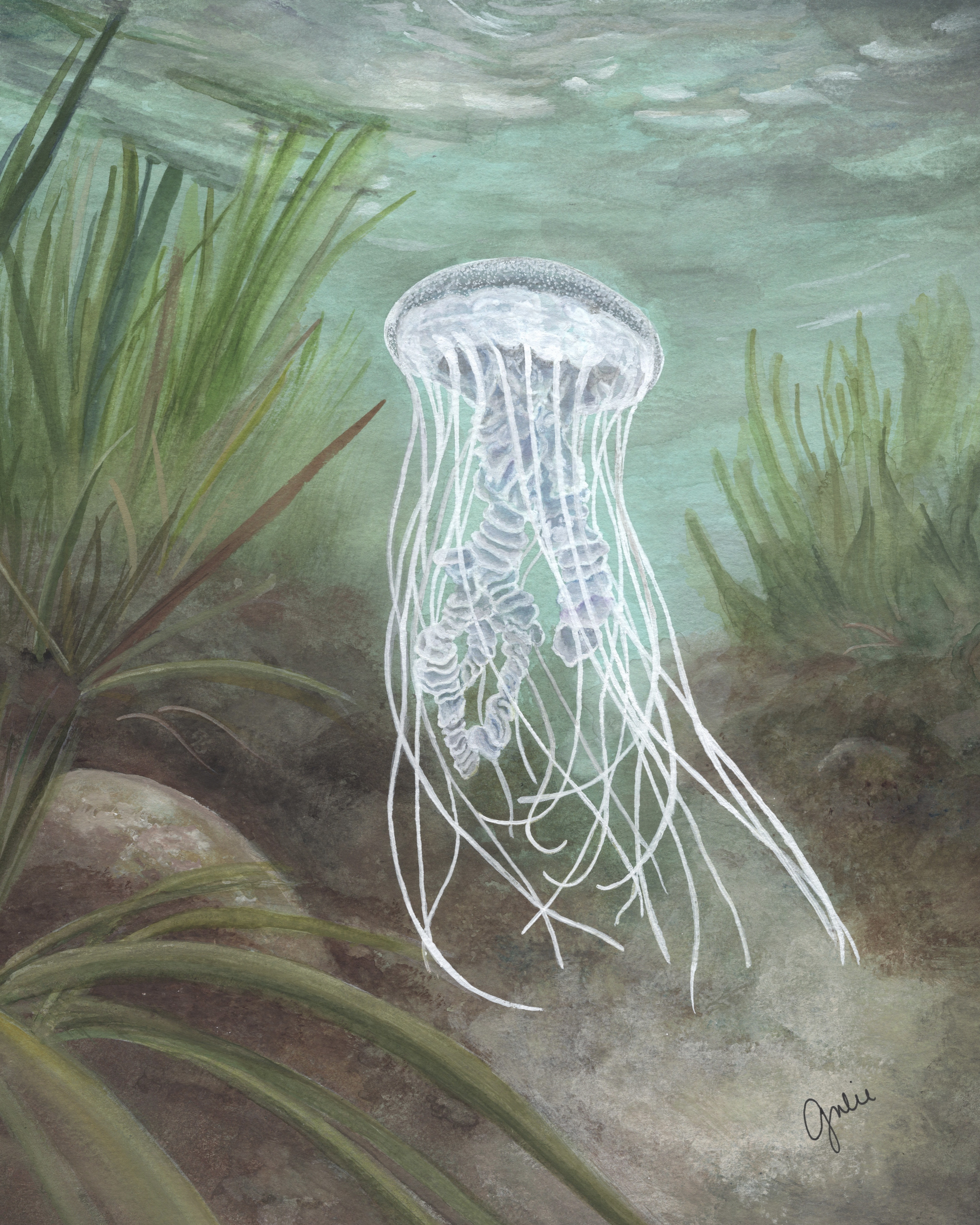
Meet the Atlantic Bay Nettle
The Chesapeake Bay is home primarily to three true jellyfish (Scyphozoans): the Bay Nettle (Chrysaora), the Lion’s Mane jellyfish (Cyanea), and the Moon jellyfish (Aurelia). The bay nettles, with their painful stings, are famously the bane of swimmers in the Bay during warm seasons. They are distributed throughout the middle and lower regions and their tributaries from spring through early fall. Just as reliably, they disappear completely in the fall once they reproduce, releasing tiny speck-sized larvae that settle on hard substrates, especially oyster shells, on the seafloor. There, they will develop through the winter months as polyps, which is a small, anemone-like body form anchored in place. As waters warm in the spring, each polyp buds off a stack of disc-shaped ephyrae, which are miniature, free-swimming juvenile jellyfish with a scalloped, star-shaped outline. In a matter of weeks, each ephyra will grow into the bell-shaped medusa we recognize as an adult Bay Nettle. They depend on sufficiently salty waters during all life stages, including the anchored polyp stage, so winter and spring salinity is a good predictor of the next year’s Bay nettles, particularly at the low-salt edges of their range.
Though swimmers know bay nettles for their sting, they occupy an important and beneficial position in the Chesapeake food web. They are voracious predators, feeding on a variety of foods, notably including the comb jelly (in technical terms, a Ctenophore), Mnemiopsis leidyi. Comb jellies are themselves effective predators of copepods and oyster larvae, and compete with a variety of juvenile fish for the same copepod prey. In summers when bay nettles are abundant, they suppress comb jelly populations, allowing copepods to proliferate, and potentially diverting more food to juvenile fish. In low-nettle years, this dynamic may reverse: Mnemiopsis blooms unchecked, copepods decline, and oyster larvae face intensified predation pressure. In short, more bay nettles may mean better-fed juvenile fish and improved oyster larval survival.
An old ‘frenemy’ with a new name
Each of the three main jellyfish in the Chesapeake is fairly easy to distinguish by appearance. But it is worth pausing to consider how challenging the earliest species identifications were for jellyfish, or any organism really. A jellyfish looks different at each life stage, resembling an anemone during development, and can grow to very different sizes depending on temperature, prey availability, or other environmental factors. When you find an organism in one place and then find what appears to be the same organism somewhere else, how do you decide if they are the same thing? If there are small differences, are they meaningful species distinctions, or just the result of different environments? And conversely, two animals that look similar might not be closely related at all, and could be separate lineages that have converged on similar forms by chance.
The Bay nettle was one such cryptic species. For nearly two centuries, the stinging nettle of the Chesapeake was assumed to be the same species as the sea nettle found along the open Atlantic coast from New England to the Gulf of Mexico, Chrysaora quinquecirrha. A few observers had noticed differences: Bigelow (1880), for example, noted that the Bay nettles seemed to mature with only 24 tentacles, compared to the 40 typical of their coastal counterparts. Even so, the prevailing view held that this difference simply reflected environmental variation, not a fully separated species.
It took DNA analysis to reveal the actual lineages. In 2017, Bayha and colleagues published a study in which they sequenced the DNA of animals from across the genus’ full geographic range and found that the Bay’s nettles form a true distinct lineage, now named Chrysaora chesapeakei. These nettles appear to be more closely related to jellyfishes off the coasts of Ireland and Namibia than to C. quinquecirrha swimming just offshore near Ocean City. Those morphological differences that Bigelow had noted were, in fact, meaningful distinctions all along.
How we track jellyfish with shed DNA
At the PhytoChop Coastal Observatory, we monitor the Choptank River weekly using environmental DNA (‘eDNA’). This technique examines fragments of genetic material shed by organisms into the water column. Jellyfish are particularly well suited to tracking by this approach: they are difficult to count using the nets, but they shed copious amounts of DNA into the water. In our growing eDNA dataset, we saw large bay nettle blooms in 2023 and 2025 but very few in 2024. That summer was preceded by heavy rainfall and the resulting relatively low winter salinity likely kept nettle numbers down. We are currently in a period of low rainfall and elevated salinity, which are conditions that favor nettle abundance, so keep an eye out this summer. But where there are nettles, there is a rich food chain at work, feeding the Bay’s juvenile fish.
Looking for More Information?
Chesapeake Bay Program. Jellyfish field guide. https://www.chesapeakebay.net/discover/field-guide/entry/jellyfish
Maryland Sea Grant. Jellyfish. https://www.mdsg.umd.edu/topics/jellyfish/jellyfish
Bayha KM, Collins AG, Gaffney PM. 2017. Multigene phylogeny of the scyphozoan jellyfish family Pelagiidae reveals that the common U.S. Atlantic sea nettle comprises two distinct species (Chrysaora quinquecirrha and C. chesapeakei). PeerJ 5:e3863. https://doi.org/10.7717/peerj.3863
Breitburg DL, Fulford RS. 2006. Oyster-sea nettle interdependence and altered control within the Chesapeake Bay ecosystem. Estuaries and Coasts 29(5):776–784. https://doi.org/10.1007/bf02786528